


1. Core concept: what is a photomultiplier tube?
A photomultiplier tube puts the external photoelectric effect and electron multiplication inside a single vacuum tube, and it remains the workhorse for detecting single-photon signals in particle physics experiments, astronomical observation and scintillator imaging.
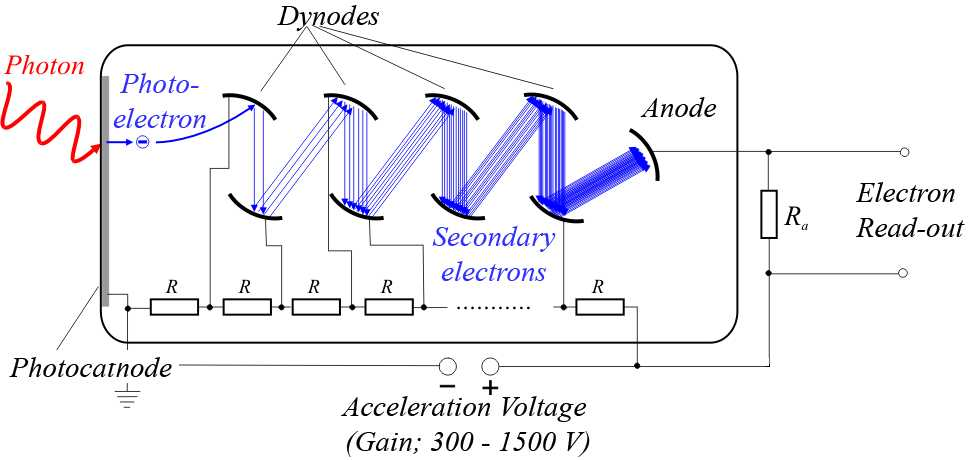
A photomultiplier tube (PMT) is a vacuum photoelectronic device based on the external photoelectric effect and multi-stage electron multiplication, offering extremely high sensitivity and very fast response. It is one of the most sensitive light detectors available today — it can detect light signals as weak as a single photon, and its output current can be amplified by several million times.
As an analogy, if an ordinary photodiode is like looking at stars with the naked eye, a photomultiplier tube is like a telescope — it amplifies extremely weak light signals to a level that can be measured cleanly. PMTs are bulky, need high-voltage power and are expensive, but in the field of ultra-weak light detection they remain irreplaceable in many high-end scientific instruments.
One might reasonably ask why a whole article is needed for a photomultiplier tube. The reason is that in ultra-weak and single-photon detection, the combination of sensitivity, speed and linear dynamic range that a PMT offers is still something many semiconductor detectors cannot surpass at the same time. Understanding the principle, the parameters and the selection method of PMTs is the first step toward using weak-light detection well.
2. Working principle: how does a photomultiplier tube work?
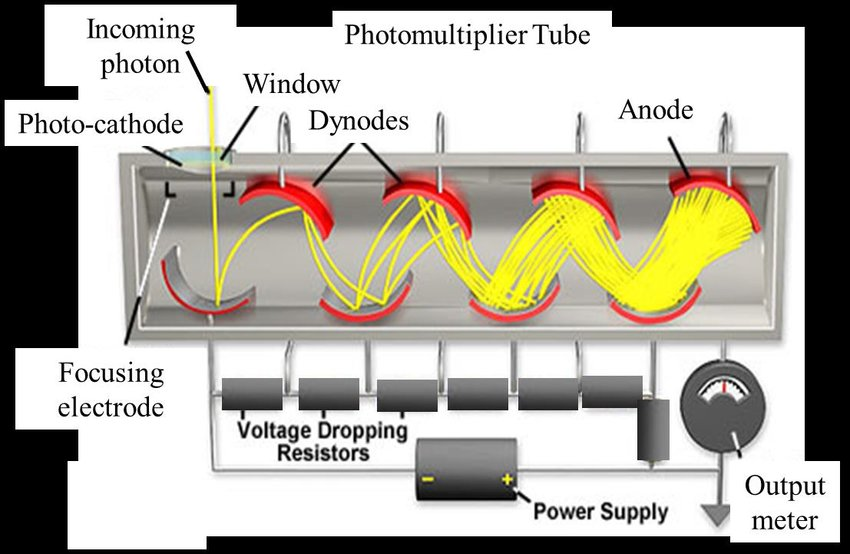
The working principle of a photomultiplier tube can be broken down into several key steps. Let us walk through them one by one:
Photoemission
Photons incident on the photocathode (photocathode) of a PMT. The photocathode is a special photoelectron-emitting material: when the photon energy is high enough, it can knock electrons out of the material and release them into the vacuum. This is the external photoelectric effect — unlike the internal photoelectric effect in semiconductors, here the electrons are genuinely emitted out of the material.
Each incident photon liberates at most one photoelectron; the quantum efficiency determines how likely that is. The photocathode material determines both the spectral response range and the quantum efficiency of the PMT.
Cascade multiplication at the dynodes
Photoelectrons emitted from the photocathode are accelerated by the high-voltage field and fly toward the first dynode (dynode). A dynode is a special secondary-electron emitting material: when a high-energy electron strikes its surface, it sputters out several secondary electrons, typically three to six.
These secondary electrons are in turn accelerated toward the next dynode, which produces yet more secondary electrons. A PMT typically contains 8 to 14 dynode stages, each multiplying the electron count several-fold. After this cascade, a single initial photoelectron can become millions of electrons — an overall gain of 10⁵ to 10⁷, or even more.
Electron collection and signal output
The large electron population produced after the last dynode stage is collected by the anode (anode), forming a measurable current pulse or a continuous current. Because the gain is so high, even a single incoming photon produces an output current pulse large enough to be detected directly by the readout electronics — this is why PMTs can perform single-photon counting.
The gain of a PMT is set by the voltage differences between stages, with a typical total supply voltage between 500 V and 3000 V. The higher the voltage, the higher the gain.
3. Key parameters: reading the performance specifications of a photomultiplier tube
Knowing the concept and the principle is not enough to evaluate a photomultiplier tube; you also need to understand its key parameters. The table below sorts out the core parameters.
| Parameter | Meaning | Why it matters |
|---|---|---|
| Quantum efficiency (quantum efficiency, QE) | The fraction of incident photons that produce photoelectrons. The quantum efficiency of a PMT is not high: typically 20–30 % at the best wavelength for bialkali photocathodes, and above 40 % for some special materials. This is inferior to semiconductor photodiodes, but the very high gain of a PMT compensates for the lower quantum efficiency. | It measures how efficiently the photocathode converts photons into photoelectrons. The higher the quantum efficiency, the more photoelectrons are produced for the same optical input and the better the signal-to-noise ratio. Although the QE of a PMT is lower than that of a silicon photodiode, its extremely low post-amplification noise and very high gain still give it strong practical detection capability in weak light. |
| Gain (gain) | The current amplification factor, i.e. the ratio of the anode output current to the photocurrent at the cathode. Typical gains range from 10⁵ to 10⁷, depending on the number of dynode stages and the operating voltage. | It sets how much the signal is amplified. High gain allows detection of extremely weak signals and even single-photon counting; but excessive gain increases dark-current noise, narrows the linear range and accelerates dynode ageing. In practice the operating voltage should be chosen in the region where the signal-to-noise ratio is optimal. |
| Dark current / dark count rate | The small residual output current that persists when no light falls on the PMT. It originates mainly from thermal emission (thermal noise), leakage and cosmic rays. The dark current sets the lowest optical signal level a PMT can detect, and cooling can reduce the dark count rate by a large factor. | The output current or count rate with no illumination is one of the main noise sources of a PMT. The smaller the dark current, the stronger the weak-light detection capability. Cooling can significantly reduce the dark current — for example, cooling to -20 °C can lower the dark count rate by more than one order of magnitude, a common technique in single-photon counting applications. |
| Rise time / response speed | The response speed of a PMT to an optical pulse, typically in the nanosecond range (1–10 ns). Because the transit time of electrons between dynodes is very short, a PMT can handle very fast optical signals, with bandwidths from several hundred MHz up to the GHz range. | It determines how quickly the PMT responds to fast optical signals. Applications such as ultrafast pulse detection and time-correlated single-photon counting (TCSPC) require fast PMTs. Linear-focused and MCP types offer the best time response. |
| Spectral response range | Determined by the photocathode material. Common bialkali materials respond roughly from 300 to 650 nm; materials such as caesium telluride (Cs-Te) extend into the ultraviolet, and multialkali materials reach the near infrared (around 850 nm). PMTs are limited at the long-wavelength end and generally do not exceed 1000 nm. | It is set by the photocathode material — bialkali, multialkali, InGaAs and so on. The response must cover the wavelength of interest, otherwise responsivity drops sharply. Note that the window material also limits transmission at the short-wavelength end (borosilicate glass cuts off around 300 nm, fused silica reaches down to 160 nm). |
| Linear range | The range over which the output current stays proportional to the incident optical power. The linear range of a PMT is wide, typically six to eight orders of magnitude. At high currents (for example anode currents above the milliampere level), however, space-charge effects and dynode fatigue cause nonlinearity. | The range in which the output current is proportional to the incident optical power. Beyond it the responsivity falls and readings are systematically low. The upper limit of the linear range is set by the anode current and space-charge effects. Measurements with a large dynamic range must keep the detector inside the linear region. |
| Time resolution | The accuracy with which the arrival time of a photon can be measured, typically tens to hundreds of picoseconds. This makes PMTs well suited to time-of-flight measurements (TOF mass spectrometry, laser ranging). | The temporal resolving capability for very short optical pulses, determined by the electron transit time and its spread. Applications requiring ultrafast timing need PMTs with high time resolution. |
4. Main types: what kinds of photomultiplier tubes are there?
Photomultiplier tubes can be classified in many ways, and each dimension reveals different aspects of their behaviour. The common ones are introduced below:
By photocathode material
#### Bialkali photocathodes (bialkali, e.g. Sb-Rb-Cs, Sb-K-Cs)
The most widely used type, highly sensitive from the visible into the near ultraviolet with low dark current. The quantum efficiency peaks around 400 nm and can reach 25–30 %.
#### Multialkali photocathodes (multialkali, e.g. Na-K-Sb-Cs)
A broader spectral response, from the ultraviolet to the near infrared (around 850 nm), but with a higher dark current.
#### Caesium telluride / caesium antimonide photocathodes
Used in the ultraviolet; solar-blind types are insensitive to visible light and respond only in the UV.
#### InGaAs photocathodes
They extend into the near infrared (around 1700 nm) but require cryogenic cooling and offer no advantage over semiconductor InGaAs detectors, so they are used relatively rarely.
By dynode structure
The geometric arrangement of the dynodes directly affects key PMT performance factors such as time response, gain uniformity and collection efficiency. The common types are listed below (RP Photonics Encyclopedia – Photomultipliers):
#### Box-and-grid dynodes (box-and-grid)
Composed of a series of quarter-cylinder dynodes, widely used in end-window PMTs. They feature high electron collection efficiency and good response uniformity, which suits large-area photocathodes. The time response is only moderate, making them appropriate where speed requirements are modest but uniformity matters.
#### Linear-focused dynodes (linear-focused)
The dynodes are arranged in a straight line and the electrons are focused as they fly between stages, so the transit-time spread is extremely small. They offer very fast time response, high time resolution, good pulse linearity and large output current, and are the preferred choice for high-speed applications such as time-correlated single-photon counting (TCSPC) and time-of-flight measurements.
#### Venetian blind dynodes (venetian blind)
The dynodes are arranged as parallel venetian-blind plates with a large surface area. They feature good gain uniformity and large output current and are mainly used in PMTs with large-area photocathodes. The time response is slower, so they suit situations where timing demands are low but uniform large-area detection is needed.
#### Circular-focused dynodes (circular-focused / circular-cage)
The dynodes are curved along a circular arc, giving a very compact structure. They offer fast response, high gain and relatively low operating voltage. They are common in side-on PMTs, whose small size makes them convenient for instruments such as spectrophotometers.
#### Microchannel plate types (MCP-PMT)
They replace the discrete dynodes with a microchannel plate, where electrons are multiplied by continuous secondary emission along the inner walls of microscopic channels. They feature extremely fast response (sub-nanosecond rise time), very high time resolution (picosecond level) and strong resistance to magnetic fields. They are used in advanced applications such as ultrafast time-resolved measurements and position-sensitive detection.
By window material
#### Borosilicate glass windows (borosilicate glass)
For the visible range and inexpensive; the short-wavelength cutoff is about 300–350 nm.
#### UV glass windows (ultraviolet glass)
They transmit ultraviolet light down to about 200 nm.
#### Fused silica windows (fused silica)
Good transmission deep into the UV, reaching 160 nm and even shorter wavelengths.
#### Sapphire windows (sapphire)
For still shorter ultraviolet wavelengths, i.e. vacuum-ultraviolet applications.
By package and form factor
#### End-window types (head-on / end-window)
Light enters through the flat end face of the tube; the photosensitive area is large and this is the most common type. Usually combined with box-and-grid or venetian-blind dynodes for good uniformity.
#### Side-on types (side-on)
Light enters from the side and a reflective photocathode is used, which keeps the package small. Common in spectrophotometers and photometers, usually paired with circular-focused dynodes.
#### Array types (array)
Several PMTs are integrated or arranged in an array for multichannel detection or position resolution.
Each type of photomultiplier tube has its own advantages and drawbacks; there is no absolute “best,” only the “most suitable.” The choice should follow the specific application — the required speed, the required sensitivity, the photosensitive area, the budget and other practical constraints.
5. Applications: where are photomultiplier tubes used?
Photomultiplier tubes are used mainly where extremely weak light must be detected with very high sensitivity, and the range of applications is broad:
- Particle and nuclear physics: neutrino detection, cosmic-ray observation and high-energy physics experiments. The Super-Kamiokande neutrino detector in Japan, for instance, uses more than ten thousand large PMTs to detect Cherenkov radiation.
- Medical imaging: in nuclear medicine imaging systems such as positron emission tomography (PET) and single-photon emission computed tomography (SPECT), PMTs work with scintillator crystals to detect gamma photons.
- Fluorescence detection and analysis: in biomedical instruments such as fluorescence spectrometers, flow cytometers, quantitative PCR and chemiluminescence detectors, where extremely weak fluorescence signals must be measured.
- Raman spectroscopy: Raman-scattered light is very weak, and the high sensitivity of PMTs has made them the classic detector for Raman spectrometers.
- Laser ranging and LiDAR: early high-precision laser rangers used PMTs widely as the receive detector. Although APDs and silicon photomultipliers (SiPMs) have replaced PMTs in many cases in recent years, PMTs still hold advantages where ultra-high sensitivity is required.
- Astronomical observation: on telescopes, for detecting the faint light of distant objects, especially in the ultraviolet and visible.
- Environmental monitoring: weak-light detection in instruments for atmospheric particulate measurement and water-quality analysis.
- Photon counting and quantum optics: PMTs can be operated in photon-counting mode for single-photon-level quantum optics experiments.
6. Common misconceptions
Many beliefs about photomultiplier tubes are plausible but wrong. Check whether any of the following misconceptions apply to you:
Misconception 1: PMTs have a higher quantum efficiency than semiconductor detectors, so they are more sensitive
The opposite is true — the quantum efficiency of a PMT is usually far below that of a semiconductor photodiode (silicon detectors reach 80–90 %, PMTs typically only 20–30 % or even less). The advantage of a PMT is not quantum efficiency but extremely low noise combined with very high gain. Because the internal gain is large while the added noise is small, the output signal can be measured almost directly and is hardly affected by downstream electronics noise. Overall a PMT still detects very weak light very well, but its photon “capture rate” is in fact lower than that of a good semiconductor detector.
Misconception 2: PMTs are too bulky and have been superseded by semiconductor detectors
Semiconductor detectors such as APDs and SiPMs (silicon photomultipliers) do replace PMTs in an increasing number of applications, but PMTs retain advantages that cannot be matched in certain respects. A PMT’s photosensitive area can be very large, from a few centimetres to tens of centimetres, which is hard for a single semiconductor detector to match; the gain uniformity of a PMT is good and stays consistent over a large area; and its time resolution and linear dynamic range remain advantageous. In large-scale physics experiments and large-aperture imaging, PMTs are still the first choice.
Misconception 3: PMTs can only measure visible and ultraviolet light
Most conventional PMTs do indeed work mainly from the ultraviolet through the visible and near infrared (up to roughly 850–1000 nm), because the external photoelectric effect requires the photon energy to exceed the work function of the photocathode material, and long-wavelength photons do not. But this does not mean PMTs “can only measure short wavelengths” — near-infrared-sensitive PMTs do exist (Ag-O-Cs photocathodes reach 1200 nm, InP/InGaAs photocathodes reach 1700 nm); they simply have low quantum efficiency and high dark current, so their performance is not ideal. Above 1000 nm, semiconductor detectors (InGaAs, HgCdTe and others) are usually the better choice.
Misconception 4: higher gain is always better — turn up the voltage and the sensitivity follows
The gain of a PMT does increase with the operating voltage, but higher is not better. Too much voltage causes the dark current to rise sharply, accelerates dynode ageing, degrades the linear range and can even trigger arcing and damage. And in most cases what limits detection sensitivity is not insufficient gain but dark noise and background light noise. Past a certain gain, raising the voltage further only amplifies noise and does not improve the signal-to-noise ratio. Choose the operating voltage near the optimum signal-to-noise ratio for the application rather than chasing high gain blindly.
7. Recommended reading
- What is a photodiode? The most basic light-detecting device
- What is an avalanche photodiode? A high-sensitivity detector with built-in gain
- Photodetector noise and signal-to-noise ratio
- What is a power meter? How to measure laser power accurately
References:
- RP Photonics Encyclopedia – Photomultipliers
- Hamamatsu Photonics – Photomultiplier Tubes: Basics and Applications (Third Edition)
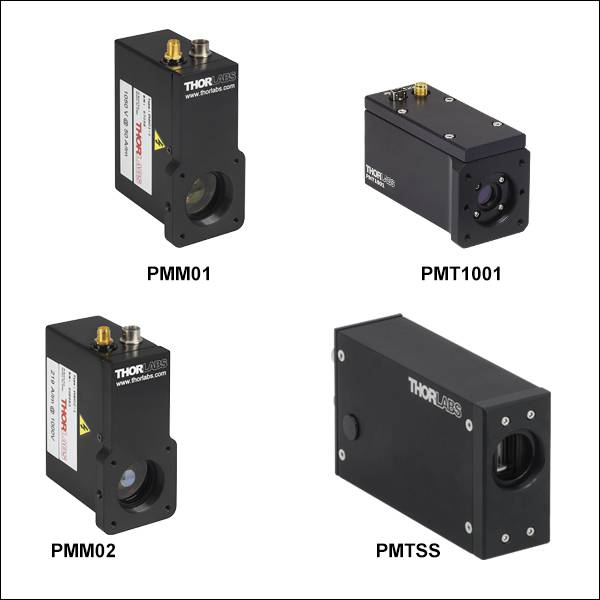
- Thorlabs – Photomultiplier Tube (PMT) Modules Technical Documentation
Leave a Reply