


If most lasers are like “paintbrushes with a fixed colour,” then the dye laser is more like a “palette” – it can continuously tune its wavelength across tens or even hundreds of nanometres, from the near-UV to the near-IR, letting you choose almost any wavelength you want.
As the most distinctive “liquid laser” in the laser family, the dye laser has written a vivid chapter in the history of laser development: it was the first truly practical broadly tunable laser and one of the earliest sources of femtosecond pulses. Today we take a comprehensive look at this “veteran” of the laser world.
Table of Contents
I. Core Concepts: What Is a Dye Laser?
A dye laser uses organic dye molecules as its gain medium. The dye is typically dissolved in a liquid solvent (ethanol, methanol, water, etc.), so it belongs to the category of liquid lasers – something of an “outlier” in a laser family dominated by solid-state, gas, and semiconductor devices.
The core and most distinctive advantage of dye lasers is their extremely broad wavelength tuning range:
- A single dye can tune continuously over 30-100 nm
- By switching dyes, coverage spans near-UV to near-IR – nearly the entire visible spectrum and adjacent bands
To use an analogy: if an ordinary laser is a “single-colour paintbrush,” a dye laser is a “palette” – you can freely choose the wavelength you want across a very wide range.
Historical significance:
- In 1966, Sorokin & Lankard (IBM) and Schafer et al. independently invented the dye laser at nearly the same time
- In 1967, the flashlamp-pumped dye laser appeared
- In 1970, the first continuous-wave (CW) dye laser was built
- The dye laser was the first truly practical broadly tunable laser and one of the earliest femtosecond laser sources
II. How It Works: How Does Dye Emit Laser Light?
1. Energy-Level Structure: A Four-Level Vibrational System
Dye molecules are complex organic macromolecules with a dual structure of electronic and vibrational energy levels – a typical four-level vibrational system:
- Pump absorption: dye molecules absorb pump energy and make a vertical transition from the ground state S0 (v=0) to a vibrational level of the excited state S1 (Franck-Condon principle)
- Rapid non-radiative relaxation: molecules quickly relax to the lowest vibrational level of S1, releasing heat
- Stimulated emission: transition from S1 (v=0) to the various vibrational levels of S0, producing stimulated emission
- Rapid non-radiative relaxation: molecules reaching high vibrational levels of S0 quickly relax back to the ground state
Because vibrational levels broaden and merge into a continuum in liquids, the gain bandwidth is very broad (tens to hundreds of nanometres) – this is the physical basis for the broad tunability of dye lasers.
2. The Triplet-State Problem
Dye molecules have one “trouble”: excited singlet-state S1 molecules can cross over into the triplet state T1 via intersystem crossing. The triplet state has a long lifetime (microseconds to milliseconds) and absorbs light at the laser wavelength, which in severe cases can “quench” the laser.
Solutions:
- Flow the dye solution rapidly through the pump region (dye jet) – the triplets are swept away before they can accumulate
- Add triplet quenchers (such as cyclooctatetraene)
- Use pulsed pumping – the pulse is shorter than the triplet accumulation time
3. Wavelength Tuning Principle
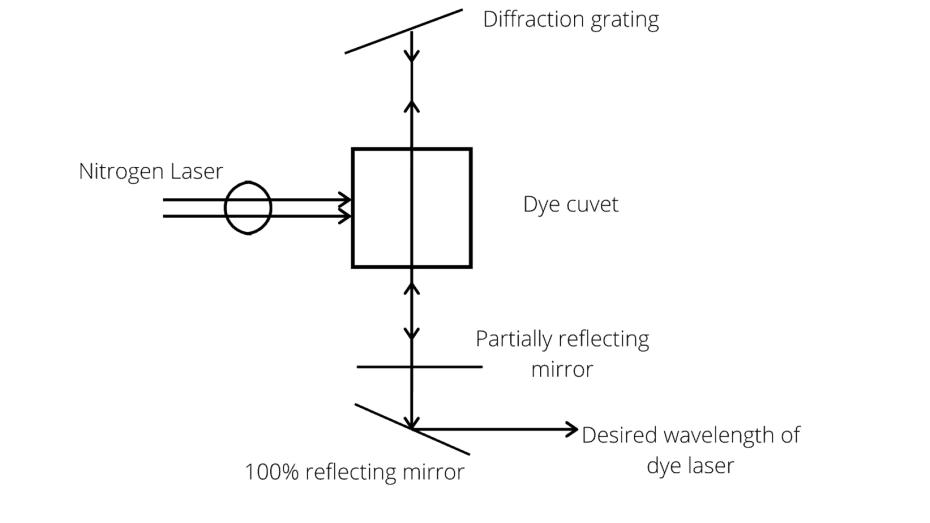
The gain bandwidth of a dye is broad, but to output a specific wavelength, frequency-selective elements must be placed inside the cavity:
- Diffraction grating: selects wavelength via dispersion; rotating its angle provides tuning
- Birefringent filter (Lyot filter): selects wavelength via polarisation interference
- Prism: disperses wavelengths; adjusting the cavity mirror selects the wavelength
- Etalon: further narrows the linewidth for single-longitudinal-mode operation
By combining multiple frequency-selective elements, single-frequency tunable output with sub-MHz ultra-narrow linewidth can be achieved.
4. Typical Configurations
- Dye jet: most common; the solution forms a thin jet with no window losses and good heat dissipation
- Dye cell: solution held in a quartz cuvette; simple structure but with window losses
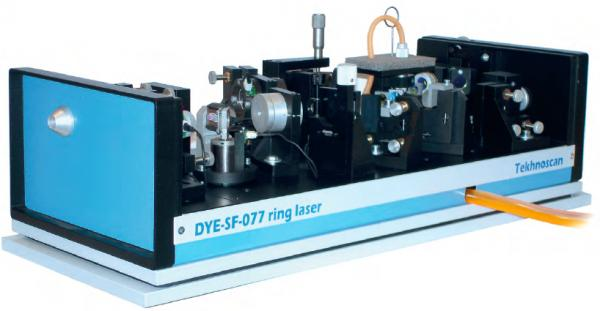
- Ring-cavity dye laser: mainstream scheme for CW single-frequency operation; travelling-wave operation avoids spatial hole burning
III. Key Parameters
| Parameter | Meaning | Typical Value |
|---|---|---|
| Tuning range | Range of output wavelengths | 30-100 nm for a single dye |
| Output power | Continuous-wave output power | 10 mW to 1 W (CW) |
| Linewidth | Spectral linewidth | Broadband: nm scale; single-frequency: MHz to sub-MHz |
| Pulse energy | Single-pulse energy of a pulsed laser | mJ to J class (lamp-pumped) |
| Pulse width | Pulse duration | ns to fs scale |
| Beam quality | M² | Usually close to diffraction-limited |
IV. Types
By operating mode
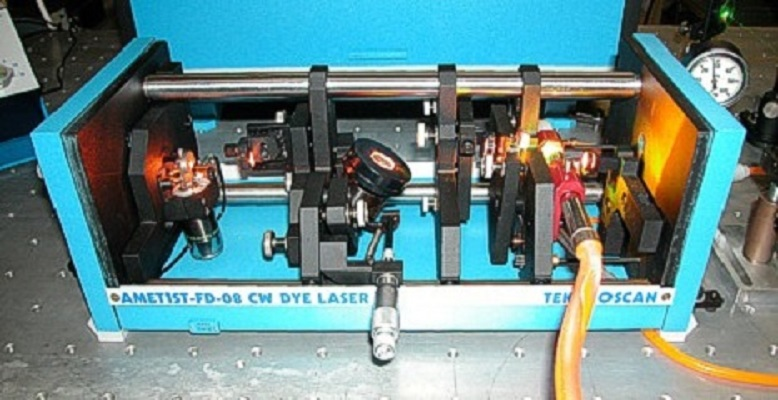
- Continuous-wave (CW) dye laser: argon-ion laser pumping + ring cavity + dye jet; narrow linewidth, mainstay of high-resolution spectroscopy
- Pulsed dye laser: flashlamp or laser pumping; high pulse energy, for medical and industrial applications
- Mode-locked dye laser: generates picosecond/femtosecond ultrashort pulses; pioneer of ultrafast optics
By pumping method
- Laser pumping: argon-ion laser, frequency-doubled Nd:YAG, excimer laser, nitrogen laser, etc.
- Flashlamp pumping: simple structure, high pulse energy, but low efficiency and poorer beam quality
Common dyes and their wavelength ranges:
| Dye | Colour | Typical tuning range | Pump wavelength |
|---|---|---|---|
| Rhodamine 6G (R6G) | Yellow-red | 560 ~ 635 nm | 532 / 514 nm |
| Coumarin | Blue-green | 420 ~ 560 nm | UV / 355 nm |
| Oxazine | Red-near-IR | 650 ~ 750 nm | Green |
| Cyanine | Near-IR | 700 ~ 1000+ nm | Red/green light |
| Exalite series | UV | 300 ~ 400 nm | Deep UV |
V. Applications
1. High-Resolution Laser Spectroscopy
The broad tunability plus narrow linewidth of dye lasers make them the “gold standard” light source for atomic and molecular spectroscopy:
- Atomic physics research (energy-level structure, hyperfine structure measurements)
- Molecular spectroscopy (rovibrational levels, molecular constants)
- Laser cooling and atom traps (an important early tool)
- Cavity ring-down spectroscopy, intracavity absorption spectroscopy, and other sensitive detection methods
2. Medical and Aesthetic Applications (Pulsed Dye Laser)
The pulsed dye laser (PDL) is a classic gold-standard device in dermatology:
- Vascular skin conditions: port-wine stains, hemangiomas, telangiectasia – the 595 nm wavelength is strongly absorbed by hemoglobin, and selective photothermolysis seals the abnormal vessels
- Scar treatment, skin rejuvenation and wrinkle reduction, rosacea
3. Ultrafast Optics and Ultrashort Pulses
- Dye lasers pioneered femtosecond lasers – the earliest femtosecond pulses came from mode-locked dye lasers
- Colliding-pulse mode-locked (CPM) dye lasers were once the workhorse of femtosecond science
- They drove advances in ultrafast spectroscopy, attosecond physics, and other frontiers
4. Environmental Monitoring and Combustion Diagnostics
- Laser-induced fluorescence (LIF): detecting OH, NO, and other radicals in flames
- Atmospheric pollutant detection
- Raman spectroscopy for temperature and concentration measurement
5. Photochemistry and Photobiology
- Photochemical reaction studies
- Laser-induced fluorescence detection of biomolecules
- Photodynamic therapy research
VI. Common Misconceptions
Myth 1: Dye lasers are simple in principle – just dye plus a lamp
Correction: Dye lasers involve complex physics such as electronic-vibrational energy levels of organic macromolecules, singlet-triplet transitions, and the Franck-Condon principle. Real systems must also solve engineering problems like triplet absorption, dye degradation, and thermal lensing. A high-performance single-frequency ring dye laser is an extremely precise instrument.
Myth 2: Dye lasers only emit colorful visible light
Correction: Dye lasers cover far more than the visible range. With different dyes they can output across a broad band from near-UV (~300 nm) to near-IR (over ~1000 nm), including invisible UV and near-IR. The misconception arises because the classic Rhodamine dyes emit yellow-red light and the dye solution itself is colored.
Myth 3: Dye lasers are obsolete and completely useless
Correction: Although dye lasers have been replaced in many areas by solid-state tunable lasers such as Ti:sapphire and by OPOs – solid-state lasers are more stable, higher-power, and avoid toxic dyes – dye lasers have not fully left the stage:
- Medical: pulsed dye laser treatment of vascular skin conditions remains the gold standard
- Special wavelengths: for wavelengths hard to obtain by other means, dye lasers are still the first choice
- Intracavity absorption spectroscopy: the high gain of dye lasers suits this application especially well
- Historical significance: they ushered in the era of tunable lasers and femtosecond lasers
Myth 4: All dyes are toxic and extremely dangerous
Correction: It is true that many laser dyes (and some solvents such as DMSO) are toxic or even potentially carcinogenic, and proper protection is essential. But toxicity varies widely among dyes. Modern labs have well-established safety protocols and protective measures (fume hoods, gloves, goggles, etc.), and risks are manageable with proper procedures.
Myth 5: Tuning is as simple as swapping the dye
Correction: Not that simple! Changing dye involves more than swapping solutions: different dyes need different pump wavelengths, cavity mirror coatings must match, frequency-selective elements must be replaced or realigned, and dye concentration, solvent type, and flow rate all need optimisation. Wide-range tuning often requires switching between multiple sets of optical components.
Myth 6: Dye lasers have low power and are only for research
Correction: CW dye lasers do have modest power (mW to W), but flashlamp-pumped pulsed dye lasers can deliver high pulse energy (mJ to J) and see real use in dermatology and industrial processing. Dye laser amplifiers can boost pulse energy to very high levels.
Myth 7: Dye lasers and fibre lasers are similar – both are liquid
Correction: Completely different! A dye laser gain medium is organic dye molecules dissolved in a liquid – a true “liquid laser.” A fibre laser gain medium is rare-earth ions (erbium, ytterbium, etc.) doped into fibre glass, making it a solid-state laser – the fibre is merely a waveguide; the gain medium is solid. The two differ greatly in principle, characteristics, and applications.
References
- RP Photonics Encyclopedia – Dye Lasers
- NIST – CW Dye Lasers technical handbook
- HandWiki – Physics:Dye laser
- SPIE Field Guide to Lasers – Dye Lasers
- StudyGuides – Dye Laser (Device)
- Physics Wave – Dye Laser principles
Leave a Reply