


Laser gain crystals are the “heart” of solid-state lasers — the core gain medium that generates laser light. From ten-kilowatt industrial fibre lasers to precision medical lasers for eye surgery and femtosecond ultrafast lasers for research, all rely on laser gain crystals. In this article we systematically explore what laser gain crystals are, how they work, the main types and how to select them.

Table of Contents
- I. Core Concepts: What Is a Laser Gain Crystal
- II. Working Principle: How Laser Light Is Produced
- III. Key Parameters Explained
- IV. Classification and Main Types
- V. Application Scenarios
- VI. Common Misconceptions
- References
I. Core Concepts: What Is a Laser Gain Crystal
Laser gain crystals, also called laser crystals, are the core gain medium of solid-state lasers. Without a laser crystal there is no solid-state laser.
What is a laser gain medium? Quite simply, it is a substance that, when excited by external energy (a pump source), amplifies light of a specific wavelength (that is, provides “gain”). Place such a substance in a resonator, add sufficiently strong pumping, and laser oscillation forms and laser light is output.
To use an analogy: if a laser is a “bullet” made of light, then the gain crystal is the gunpowder — it stores the pump energy from outside and releases it as laser light at the right moment.
The basic structure of a laser gain crystal can be understood as a combination of “active ion + host crystal“:
- Active Ions: the “luminescent centres” that actually produce stimulated emission and provide gain. The vast majority are rare-earth ions (such as Nd³⁺, Yb³⁺, Er³⁺, Tm³⁺, Ho³⁺), but transition-metal ions (such as Ti³⁺, Cr³⁺) are also used
- Host Crystal: the “home” of the active ions — providing them with a stable, uniform and transparent crystal environment. The host itself generally does not luminesce, but its properties (such as thermal conductivity, hardness and spectral range) decisively affect laser performance
The most classic laser crystal is Nd:YAG (neodymium-doped yttrium aluminium garnet) — the neodymium ion (Nd³⁺) is the active ion and YAG (yttrium aluminium garnet, Y₃Al₅O₁₂) the host. Since its invention in 1964, Nd:YAG has been the “standard” of solid-state lasers and remains the most widely used laser crystal today.
II. Working Principle: How Laser Light Is Produced
1. Population Inversion and Stimulated Emission
The full name of Laser is “Light Amplification by Stimulated Emission of Radiation.” To produce laser light, you must first achieve population inversion — that is, more particles in the high energy level than in the low energy level.
In the normal (thermal equilibrium) state, the vast majority of particles are in the low energy level (ground state), with only a few in high levels. If light is incident at this point, more photons are absorbed than are produced by stimulated emission, so the light only gets weaker, not amplified.
To achieve population inversion, energy must be supplied from outside to “move” particles from low to high energy levels — this process is called pumping. Solid-state laser crystals overwhelmingly use optical pumping — early on xenon/krypton lamps, nowadays mainly semiconductor laser diodes (LDs).
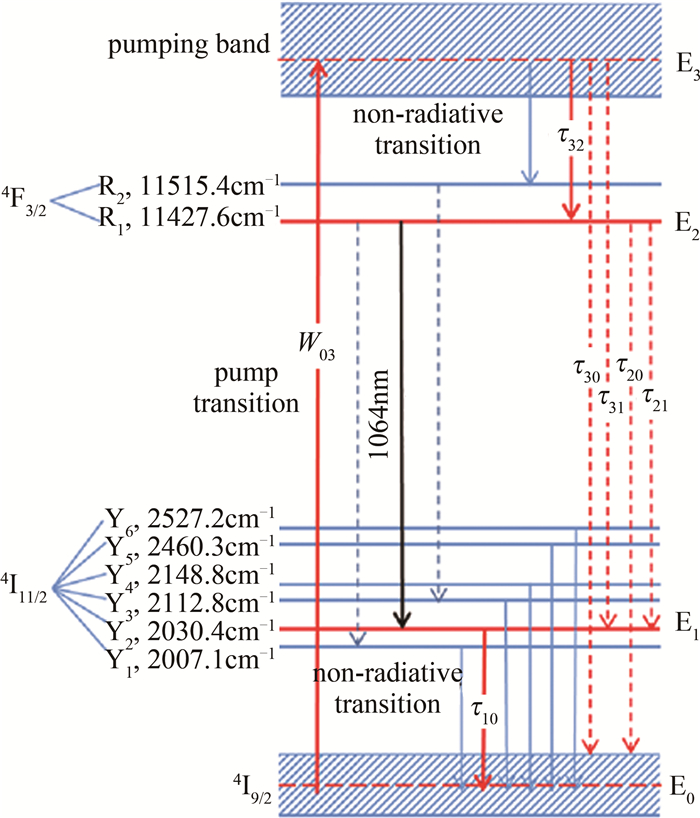
2. Energy-Level Systems: Three-Level vs Four-Level
The energy-level structure of the active ion in the crystal determines how the laser works. There are two main categories:
|
Why is population inversion easier to achieve in a four-level system? Because the lower level is almost empty to begin with — as soon as a few particles are pumped to the upper level, the upper-level population already exceeds the lower level and inversion is achieved. In a three-level system the lower level is the ground state, already crowded with particles, so you must excite more than half of all particles to achieve inversion.
3. The Complete Lasing Process (Nd:YAG as an Example)
- Pump absorption: pump light (808 nm LD) shines on the Nd:YAG crystal; Nd³⁺ ions absorb photons and jump from the ground state (⁴I₉/₂) to the pump level (⁴F₅/₂)
- Fast non-radiative relaxation: Nd³⁺ ions rapidly relax from the pump level to the metastable state (⁴F₃/₂), releasing part of the energy as heat
- Population inversion: the ⁴F₃/₂ level has a long lifetime (about 230 μs), so particles accumulate there, achieving population inversion relative to the lower level
- Stimulated emission: as a photon (1064 nm) passes, it stimulates an upper-level particle to drop to the lower level (⁴I₁₁/₂), producing an identical photon
- Resonator feedback: mirrors at both ends form a resonator; light bounces back and forth, being continuously amplified
- Laser output: when gain exceeds loss, stable laser oscillation forms and 1064 nm laser light exits through the output mirror
III. Key Parameters Explained
| Parameter name | Symbol | Meaning | Notes |
|---|---|---|---|
| Laser wavelength | λ | output laser wavelength | determined by the active ion’s energy levels |
| Absorption peak wavelength | λ_pump | optimal pump-light wavelength | used to select the pump source |
| Emission cross-section | σ_em | ability of stimulated emission | the larger, the higher the gain |
| Fluorescence lifetime | τ_f | average dwell time of particles in the upper level | the longer, the easier to store energy |
| Thermal conductivity | κ | crystal’s heat-conduction ability | critical for high-power applications |
| Quantum efficiency | η_q | photon conversion efficiency | upper-level efficiency |
| Refractive index | n | optical refractive index | affects coatings and mode field |
| Mohs hardness | – | mechanical hardness | affects processing and durability |
In-Depth Interpretation of Several Core Parameters
Emission cross-section σ_em: the core parameter measuring a laser crystal’s “amplification ability.” The larger the emission cross-section, the higher the gain a given population inversion can provide. But a large emission cross-section also means a narrow gain bandwidth — gain coefficient and bandwidth are often a trade-off.
Fluorescence lifetime τ_f: the lifetime of the upper level. The longer the fluorescence lifetime, the longer particles dwell in the high level and the easier it is to accumulate population inversion (greater energy storage). For Q-switched lasers, a long fluorescence lifetime is an advantage; for ultrafast lasers, a long lifetime is not essential.
Thermal conductivity κ: one of the most important parameters for high-power laser crystals. Laser crystals generate a great deal of heat during operation; if it is not conducted away in time, it causes thermal lensing, thermally induced birefringence, thermal stress and even crystal fracture. YAG host has excellent thermal conductivity (about 14 W/m·K), an important reason Nd:YAG became a high-power workhorse.
Quantum Defect: the difference between the pump photon energy and the laser photon energy. For example, Nd:YAG’s pump wavelength is 808 nm and laser wavelength 1064 nm, giving a quantum defect of about 24% — that is, 24% of the pump energy turns directly into heat. Yb:YAG (pump 940 nm, laser 1030 nm, quantum defect about 9%) is more efficient than Nd:YAG.
IV. Classification and Main Types
1. By Active Ion
| Active ion | Representative crystals | Typical wavelength | Features and applications |
|---|---|---|---|
| Nd³⁺ (neodymium) | Nd:YAG, Nd:YVO₄, Nd:YLF | 1064 nm, 1319 nm | most classic and widely used, four-level low threshold |
| Yb³⁺ (ytterbium) | Yb:YAG, Yb:KYW | 1030-1080nm | small quantum defect, high efficiency, first choice for high power |
| Er³⁺ (erbium) | Er:YAG, Er:Glass | 1550 nm, 2940 nm | eye-safe band, medical and dental |
| Tm³⁺/Ho³⁺ | Tm:YAG, Ho:YAG | ~2 μm, ~2.1 μm | mid-infrared, medical surgery, LiDAR |
| Ti³⁺ (titanium) | Ti:Sapphire | 650-1100nm | ultra-broad tunability, benchmark for femtosecond ultrafast lasers |
| Cr³⁺ (chromium) | ruby, Cr:LiSAF | 694 nm, tunable | earliest laser crystal, tunable near-infrared |
2. By Host Crystal
- Garnet family (YAG, LuAG, etc.): high thermal conductivity, good mechanical properties and optical uniformity; the most widely used laser host
- Vanadate family (YVO₄, GdVO₄): large absorption and emission cross-sections, high gain, but lower thermal conductivity
- Tungstate/molybdate family (KYW, KGW): broad gain bandwidth, suitable for ultrafast lasers
- Fluoride family (YLF, CaF₂): long fluorescence lifetime, low nonlinear refractive index, good UV transmission
- Glass host: can be made in large sizes at low cost, but low thermal conductivity; suitable for high-energy pulses

V. Application Scenarios
1. Industrial Laser Processing
This is the largest application market for laser crystals. Nd:YAG and Yb:YAG (and their fibre versions) are widely used in laser cutting, welding, marking, drilling and metal 3D printing. Fibre lasers use ytterbium-doped fibre as the gain medium — essentially the same principle, just with the crystal in fibre form.
2. Medical Applications
- Nd:YAG laser: surgery, ophthalmology, dermatology, dentistry
- Er:YAG laser (2940 nm): strongly absorbed by water, suitable for soft-tissue cutting and dental hard-tissue processing
- Ho:YAG laser (2100 nm): urological lithotripsy
- Ruby laser: aesthetic tattoo removal
3. Research and Defence
Ultrafast lasers (Ti:Sapphire, Yb series) are used for ultrafast dynamics research in physics, chemistry and biology; high-power lasers for laser fusion and strong-field physics; Er:glass for eye-safe laser rangefinding and LiDAR.
4. Optical Communication and Precision Measurement
The erbium-doped fibre amplifier (EDFA) is the core technology for relay amplification in optical communication; laser interferometers, laser spectrometers, LiDAR and other precision instruments also rely on various laser crystals.
VI. Common Misconceptions
Misconception 1: One laser crystal can emit only one wavelength
No. Although each active ion has a defined energy-level structure, laser transitions can occur between different pairs of levels. For example, Nd:YAG, besides the famous 1064 nm, can also produce 1319 nm, 946 nm, 1123 nm and other wavelengths. And broadband gain media such as Ti:Sapphire can be continuously tuned over 650–1100 nm — a single laser can output hundreds of wavelengths.
Misconception 2: The higher the doping concentration, the higher the laser power
Doping concentration is not the higher the better. Too high a concentration causes concentration quenching — neighboring active ions interact and dissipate the energy non-radiatively, actually reducing efficiency and fluorescence lifetime. Each crystal has an optimal doping range: for example Nd:YAG commonly uses 0.6–1.1 at.%, while Yb:YAG can reach 10–20 at.%.
Misconception 3: The more perfect the laser crystal, the better; a defect-free crystal is best
“Perfect” depends on the point of view. For continuous-wave lasing, fewer defects are indeed better. But for some applications (such as passive Q-switching and saturable absorption), a certain level of defects is actually needed to provide the function. For example Cr⁴⁺:YAG uses the saturable-absorption property of Cr⁴⁺ ions as a passive Q-switch. In addition, although ceramic laser materials are not single crystals, they allow higher doping and larger sizes.
Misconception 4: All laser crystals are pumped by LDs
Today’s mainstream LD pumping is indeed more efficient and longer-lived, but in many situations lamp pumping still has advantages: high-energy pulses (flashlamps can deliver several thousand joules of pump energy in a single pulse), cost advantages and reliability in harsh environments. Nevertheless, LD pumping replacing lamp pumping is the general trend.
Misconception 5: Thermal effects are only a concern for high-power lasers
No. Even in low- and medium-power lasers, thermal effects significantly affect beam quality and stability. Heat in the laser crystal causes thermal lensing, thermally induced birefringence, thermal stress, wavelength drift and other problems. Even for milliwatt-level single-frequency lasers, temperature stability directly affects linewidth and frequency stability. Thermal management is a core issue that cannot be avoided in the design of any solid-state laser.
Misconception 6: The thicker the gain medium, the higher the output power
A gain medium does need a certain length, but longer is not always better. Reasons: long crystals are costly and difficult to manufacture; thermal effects — the longer the crystal, the harder to dissipate heat; beam quality — thermal effects accumulate more seriously in long crystals. High-power lasers often prefer shorter, thicker crystals (or disk and fibre structures) to improve heat dissipation, rather than making longer crystals.
References
- RP Photonics Encyclopedia – Laser Crystals
- Solid-State Laser Engineering (W. Koechner)
- Principles and Technology of Lasers
- Laser Materials
Related Reading:
Leave a Reply