


What Is Active Fibre? The Fibre That Amplifies Light
Active fibre has rare-earth ions doped into its core and can produce optical gain when it is excited by pump light, which makes it the gain medium at the heart of every fibre laser and fibre amplifier. The difference from passive fibre is fundamental: passive fibre can only carry light, while active fibre can amplify it. The sections below cover the stimulated emission, the cladding pumping, the key parameters, the main types and the engineering applications.
Table of contents
- 1. What is active fibre? Getting the core concept straight
- 2. Working principle: how active fibre is achieved
- 3. Key parameters: reading the specifications of active fibre
- 4. Main types: what kinds of active fibre are there
- 5. Applications: where is active fibre used?
- 6. Common misconceptions: pitfalls to avoid
1. Core concept: what is active fibre?
Active fibre, also called gain fibre, is a fibre whose core is doped with laser-active ions (usually rare-earth ions). It produces optical gain under pump excitation and can therefore sustain laser oscillation or amplify an optical signal. The fundamental difference from passive fibre is this: passive fibre can only transport light, while active fibre can amplify it. Active fibre is the core gain medium of fibre lasers and fibre amplifiers, and its performance directly sets the output power, the beam quality, the efficiency and the spectral characteristics of the laser or the amplifier. The vast majority of active fibres use a silica glass host doped with rare-earth ions such as ytterbium (Yb), erbium (Er) or thulium (Tm).
2. Working principle: how is active fibre achieved?
Cladding pumping in more detail
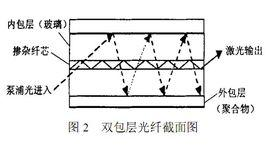
The double-clad fibre is the core structure of high-power fibre lasers and amplifiers. It has three regions:
① Core: usually single-mode, doped with rare-earth ions (such as Yb³⁺ or Er³⁺); this is where the laser light or the amplification is generated.
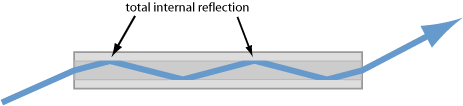
② Inner cladding: much wider than the core (typically 100-400 μm) with a larger NA (0.22-0.46), used to carry the multimode pump light. The pump light travels back and forth by total internal reflection in the inner cladding and crosses the core repeatedly, being absorbed gradually by the rare-earth ions.
③ Outer cladding: its refractive index is lower than that of the inner cladding, so it confines the pump light inside the inner cladding.
💡 Why is cladding pumping needed?
A single-mode core is very small (typically 6-10 μm), so coupling multimode high-power pump light straight into it is extremely inefficient. Cladding pumping allows a cheap multimode semiconductor laser to be used as the pump source: the pump light first enters the large inner cladding and is then absorbed step by step by the rare-earth ions in the core, which gives a high-power and highly efficient pump coupling.
Ytterbium-doped fibre (Yb³⁺)
The 900-1100 nm band, typically 1064 nm, with a high quantum efficiency; the first choice for high-power fibre lasers
Erbium-doped fibre (Er³⁺)
The 1530-1565 nm band (the C band), which matches the low-loss window of optical communications; the core of the optical amplifier
Thulium-doped fibre (Tm³⁺)
The 1800-2100 nm band, used for mid-infrared lasers and medical applications
Er:Yb co-doped fibre
The Yb ions absorb the pump light efficiently and transfer the energy to the Er ions, which raises the pumping efficiency
Neodymium-doped fibre (Nd³⁺)
Can operate near 0.9 μm and 1.06 μm
The working principle of active fibre rests on stimulated emission. When the pump light (shorter wavelength, higher energy) enters the rare-earth doped core, the rare-earth ions absorb the pump photons and jump from the ground state to a higher level. After a fast non-radiative relaxation the ions reach the metastable level. If signal light (longer wavelength, lower energy) is present at that moment, the ions in the metastable state are “stimulated” by the signal photons and fall back to the ground state, releasing a photon identical to the signal photon — this is stimulated emission, and the signal light is amplified.
To obtain a net gain the population inversion condition must be met, that is, the population of the upper level must exceed that of the lower level, which needs a sufficiently strong pump light. The size of the gain depends on several factors: the type and concentration of the dopant, the fibre length, the pump power and wavelength, and the signal wavelength.
The common dopants differ widely in their working bands: ytterbium covers 900-1100 nm, erbium 1530-1565 nm, thulium 1800-2100 nm, holmium reaches 2-3 μm, and neodymium sits near 0.9 μm and 1.06 μm.
There are two main pumping schemes: core pumping (the pump light goes straight into the core) and cladding pumping (the pump light enters the inner cladding and crosses the core many times to be absorbed in a double-clad fibre). Almost every high-power fibre laser uses cladding pumping, because a high-power multimode laser diode can then serve as the pump source.

3. Key parameters: reading the specifications of active fibre
Photodarkening
Photodarkening is a loss increase that appears in ytterbium-doped and other active fibres under high-power pumping: as the pumping time grows, colour centres form gradually in the core, the additional absorption loss rises and the output power falls.
Photodarkening occurs mainly in ytterbium-doped silica fibre and depends on the pump power density, the doping concentration and the core temperature. Erbium-doped fibre is affected far less. Optimising the composition (co-doping Al or P, for instance) and the process suppresses it effectively.
Large mode area (LMA) fibre
Large mode area (LMA) fibre is a special active fibre designed to raise the power handling of a single-mode fibre. A standard single-mode fibre has a small mode field area (about 80 μm²) and develops nonlinear effects (SBS, SRS) and fibre damage easily at high power.
LMA fibre enlarges the mode field area by increasing the core diameter (up to 20-40 μm and beyond) and at the same time lowers the NA (typically below 0.08) to keep a single-mode or nearly single-mode beam quality. The mode field area of LMA fibre can be 5 to 20 times that of a standard single-mode fibre, which raises the nonlinear and the damage thresholds considerably.
💡 The challenges of LMA fibre
Once the core is widened the V parameter grows and several modes may be supported. To keep a single-mode output the usual remedies are a lower NA, bend-induced mode filtering and a photonic crystal fibre. LMA fibre is also more sensitive to bending — a bend radius that is too small produces a high loss.
Core formulas
Small-signal gain: the small-signal gain coefficient g₀ of an active fibre is proportional to the upper-level population density N₂:
g₀ = σ_e(λ) · N₂
where σ_e(λ) is the stimulated emission cross-section, which depends on the wavelength. The gain accumulates along the length z of the fibre:
G(z) = exp(g₀ · z) = exp(σ_e · N₂ · z)
Saturation power: as the signal power rises far enough the gain starts to fall. The gain saturation formula is:
g(P) = g₀ / (1 + P/P_sat)
where P_sat = hν · A_eff / (σ_e · τ) is the saturation power, τ the upper-level lifetime and A_eff the effective mode field area.
Cladding pump absorption efficiency: in a double-clad fibre the pump light is reflected back and forth through the core, and the absorption efficiency depends on the shape of the inner cladding and on the core-to-inner-cladding area ratio. A circular inner cladding gives a low absorption because of the helical ray paths, while D-shaped and hexagonal inner claddings raise the absorption efficiency considerably.
Reading the key parameters is the starting point for assessing the performance of active fibre. The table below sets out the main specifications and what they mean:
| Parameter | Meaning | Engineering significance |
|---|---|---|
| Dopant type and concentration | Sets the gain wavelength and the gain coefficient; an excessive concentration causes concentration quenching | It sets the wavelength at which the gain appears, and an excessive concentration causes concentration quenching, which lowers the gain again. |
| Core absorption coefficient | The absorption of the pump light per unit length of core, in dB/m | A stronger absorption takes more of the pump power in the core, but too much of it also brings on concentration quenching. |
| Cladding absorption coefficient | The absorption of the pump light per unit length of the cladding in a double-clad fibre | It sets how much of the pump light the core actually absorbs and is the central figure in the design of a double-clad structure. |
| Numerical aperture (NA) | Affects the mode field characteristics and the pump coupling | Sets the pump coupling efficiency and the mode characteristics |
| Cutoff wavelength | Guarantees single-mode or few-mode operation | A key parameter of single-mode fibre; below it the fibre works in a multimode state, develops modal dispersion and loses transmission quality and bandwidth. |
| Gain efficiency | The gain produced per unit of pump power | It measures how much gain a watt of pump power buys and therefore sets the output capability of the fibre laser. |
| Optical-to-optical efficiency | The ratio of the output optical power to the pump optical power | It sets how much of the pump power actually comes out as laser light, and it is pulled down by the thermal and the signal-extraction losses. |
| Mode field diameter / effective mode field area | Sets the power handling and the nonlinear effects | It reflects the region of the fibre that actually carries the light more accurately than the core diameter and directly sets the connection loss, the bend loss and the dispersion. |
| Photodarkening resistance | The resistance to photodarkening, which affects the long-term stability | A component with a strong photodarkening shows a clear power decay after a few hours of continuous high-power operation. |
4. Main types: what kinds of active fibre are there?
Comparison of the common rare-earth doped active fibres
| Dopant | Laser band | Upper-level lifetime | Main applications |
|---|---|---|---|
| Yb³⁺ (ytterbium) | 975-1200 nm (centred around 1064 nm) | ~1ms | High-power fibre lasers, fibre amplifiers |
| Er³⁺ (erbium) | 1530-1565 nm (C band) | ~10ms | EDFA optical amplifiers, optical communications |
| Tm³⁺ (thulium) | 1800-2100nm | ~0.5ms | 2 μm lasers, medical applications, sensing |
| Er:Yb co-doped | 1530-1565nm | Er: ~10ms | High-gain EDFA, optical amplifiers at the 1 W level |
| Nd³⁺ (neodymium) | 1064 nm, 1320 nm | ~0.2ms | Fibre lasers, amplifiers |
| Ho³⁺ (holmium) | 2000-2100nm | ~8ms | 2 μm lasers, surgical applications |
Active fibre can be classified in many ways, and each dimension helps you understand its characteristics from a different angle. The most common ones are introduced below:
By dopant
Ytterbium-doped fibre
The main gain medium of high-power fibre lasers
Erbium-doped fibre
The core of the C-band optical amplifier (EDFA)
Thulium-doped fibre
Lasers and amplifiers in the 2 μm band
Er:Yb co-doped fibre
Erbium gain fibre with efficient pumping
Holmium-, neodymium- and dysprosium-doped fibre and other rare-earth dopings
Holmium-, neodymium- and dysprosium-doped fibre and other rare-earth dopings each have their own band and characteristics, and they cover different application needs.
By waveguide structure
Single-clad active fibre
Only a core and a cladding, the pump light goes straight into the core; used in low-power devices
Double-clad active fibre
An inner and an outer cladding, the pump light travels in the inner cladding; the standard structure for high-power fibre lasers
Triple-clad active fibre
Further optimisation of the pump absorption and the mode control
Photonic crystal active fibre
An air-hole cladding design, which allows a large mode area with single-mode transmission
By special performance
Polarisation-maintaining active fibre
The polarisation-maintaining version of the gain fibre, used in polarisation-maintaining lasers
Large mode area (LMA) active fibre
A large core design that raises the power handling
Special active fibre
Special versions such as radiation-hard and high-temperature ones
5. Applications: where is active fibre used?
The applications of active fibre span several fields; the main directions are:
- Fibre lasers: active fibre is the gain medium of a fibre laser, and the high-power fibre lasers used for industrial cutting and welding (from the kilowatt up to tens of kilowatts) all use ytterbium-doped double-clad fibre
- Fibre amplifiers: the erbium-doped fibre amplifier (EDFA) is a key device of optical communication systems and is used to amplify the optical signal; there are also power amplifiers for laser systems
- Pulsed fibre amplifiers: for amplifying femtosecond or picosecond pulses, used in research, medicine and precision machining
- Supercontinuum sources: the high-power pulses produced in active fibre are combined with nonlinear effects to generate a broadband supercontinuum spectrum
- Fibre sensing: active fibre is also used in specific sensing applications, such as Raman amplification in distributed temperature sensing
- Medical lasers: thulium-doped fibre lasers output at 2 μm and are used for soft-tissue cutting and other surgical procedures
👉 Want to see more real application cases? Visit the application case page of Soar Laser, or contact our technical team directly for professional advice.
6. Common misconceptions
Misconception 1: active fibre is just a fibre with rare-earth ions in it
That is not accurate enough. The defining feature of active fibre is that it can amplify light by stimulated emission, and doping with rare-earth ions is the most common way of doing that, but not the only one. A fibre with rare-earth ions in it is not necessarily “active” either — it only becomes active when pump light produces the population inversion. Without pumping, a doped fibre may behave as an absorbing medium (a passive state).
Misconception 2: the higher the doping concentration, the larger the gain
The doping concentration is not the higher the better. Too high a concentration causes concentration quenching — a non-radiative energy transfer between neighbouring dopant ions turns the excitation energy into heat instead of radiation, which lowers the gain efficiency. A high concentration can also bring on photodarkening, so that the loss of the fibre grows with the operating time. The doping concentration therefore has to be balanced between the gain efficiency and the various side effects.
Misconception 3: in a double-clad fibre the pump light travels in the core
In a double-clad fibre the pump light travels in the inner cladding, not in the core. The core is very thin (single-mode), so it is hard to couple high-power multimode pump light into it directly, while the inner cladding is much wider (typically 105-400 μm) and has a larger numerical aperture, which lets it take in the multimode pump light efficiently. The pump light is reflected back and forth inside the inner cladding and is partly absorbed by the dopant each time it crosses the core, which is what produces the population inversion and the amplification of the signal. That is the central idea of cladding pumping.
Misconception 4: all rare-earth dopants have their gain in the near infrared
The gain bands of the different rare-earth ions differ a great deal. Erbium (Er³⁺) works near 1550 nm, ytterbium (Yb³⁺) in the 900-1100 nm band and thulium (Tm³⁺) in the 1.8-2.1 μm band — these are indeed in the near infrared. But holmium (Ho³⁺) can work in the 2-3 μm mid-infrared, and thulium can be pushed beyond 2 μm. More importantly, by using the nonlinear effects in the fibre (Raman scattering, supercontinuum generation, for instance), an active-fibre system can produce an extremely broad spectrum from the ultraviolet to the mid-infrared.
7. Recommended reading
- What is single-mode fibre? Why communication networks use it
- What is polarisation-maintaining fibre? How to stop the polarisation drifting
- What is a gain medium? The core amplification material in a laser
- What is a fibre laser? Why it dominates the industrial laser market
- Single-frequency fibre lasers: principles and applications in full
- What is an optical power meter? How to measure laser power accurately
- What is an optical spectrum analyser? How to analyse the colour content of a laser
Leave a Reply