


SEO meta description (Yoast / GEO, ≤150 chars): The MOPA fibre laser uses a “seed source + fibre amplifier” architecture, with independently adjustable pulse width (2–500 ns) and repetition rate, suited to fine marking, anodized-aluminium black marking, colour marking, thin-sheet cutting and laser cleaning. This article explains its principle, parameters, the difference from Q-switched and how to select.
What is a MOPA Fibre Laser? Working Principle, Parameters and the Difference from Q-Switched | Soar Laser Encyclopedia
Updated: 2026-10-11 | Soar Laser (Soar Laser) Laser Encyclopedia
Bottom line: A MOPA fibre laser uses a two-stage “seed source + fibre amplifier” architecture that decouples pulse width, repetition rate and peak power, allowing one machine to do low-heat fine marking, black marking on anodized aluminium and colour marking, as well as high-energy deep engraving, thin-sheet cutting and laser cleaning. If your process switches materials frequently or is especially sensitive to heat effects, MOPA is usually a better fit than a fixed-pulse-width Q-switched laser.
Contents
- I. Overview: what exactly is MOPA
- II. Working principle: seed source + fibre amplifier
- III. Key parameters
- IV. Common myths
- V. MOPA vs Q-switched fibre lasers
- VI. Application scenarios
- VII. Selection FAQ
- VIII. Recommended reading
- References
I. Overview
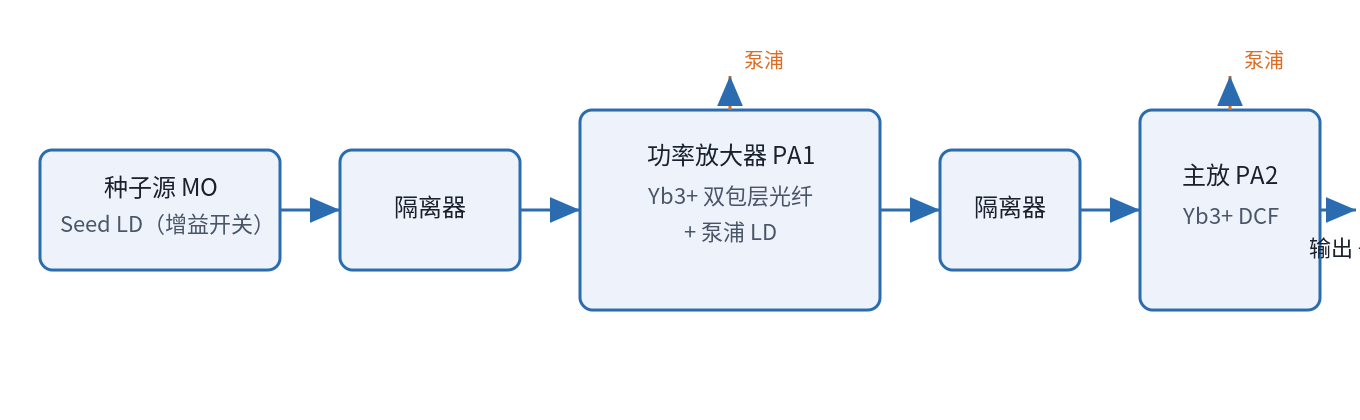
A MOPA fibre laser, short for Master Oscillator Power Amplifier, is a pulsed fibre-laser architecture that separates the two steps of “generating light” and “amplifying light.” The master oscillator (MO, seed source) first generates low-power, highly controllable seed pulses; the power amplifier (PA, fibre amplifier) then amplifies this seed light step by step to the average and peak power required industrially, while preserving as much as possible the original wavelength, repetition rate and pulse waveform.
Remember it in one line: the seed source “makes good light,” the fibre amplifier “makes it strong.”
Unlike conventional pulsed fibre lasers that rely on a resonant cavity with a Q-switch for Q-switching, MOPA’s greatest value is that — pulse width, repetition rate and peak power can be adjusted independently of one another. This is the fundamental reason it is more flexible than an ordinary Q-switched fibre laser in fine marking, colour marking and thin-sheet cutting.
The typical operating wavelength is near-infrared 1064 nm (ytterbium-doped Yb3+ fibre); mainstream industrial brands include Raycus, JPT and IPG.
II. Working principle
1. Master oscillator (MO / seed source)
Usually a directly current-modulated semiconductor laser diode (gain-switched LD), outputting seed pulses of only tens of milliwatts. Because the power is very low, pulse width, repetition rate and waveform can be precisely controlled via the drive current; a low-power fibre laser can also serve as the seed. The key point: all “time-domain characteristics” are set at the low-power end, while the high-power end only amplifies — the two do not interfere.
2. Power amplifier (PA / fibre amplifier)
Uses ytterbium-doped (Yb3+) double-clad fibre, pumped by high-power pump diodes through the cladding. When the seed light passes through the population-inverted gain fibre it stimulates emission, and photons are amplified “clone-like.” To reach industrial power, one or more cascaded amplification stages are typical (pre-amplifier + main amplifier). For double-clad fibre and gain mechanisms, see Active Fibre Encyclopedia.
3. Optical isolator
Placed between the MO and PA, and between amplifier stages, it blocks light reflected back from the workpiece or fibre end face from travelling upstream, avoiding damage to the seed source or instability. MOPA is sensitive to back-reflections, so an optical isolator is almost mandatory.
4. Gain saturation and pulse shaping
As a pulse draws stored energy from the amplifier, gain drops during the pulse (gain saturation), which can “flatten” or distort the pulse’s temporal shape; differing gain at the leading and trailing edges also causes uneven gain. In practice pre-distortion of the input waveform or gain-flattening designs are used to compensate so the output pulse approaches the intended shape.
III. Key parameters
| Parameter | Meaning | Description / typical range |
|---|---|---|
| Average power | Total energy output per unit time | Common for industrial marking: 20 W / 30 W / 60 W / 70 W / 100 W etc. |
| Peak power | Instantaneous power within a single pulse | Highest at short pulse width and low frequency; for a 30 W model about 10 kW class (varies by condition and model) |
| Pulse width | Duration of a single pulse | MOPA allows wide independent adjustment, e.g. 2–500 ns (Raycus RFL-PxxMX, JPT M7/M8 etc.) |
| Repetition rate | Pulses per second | Widely adjustable: Raycus about 1–2000 kHz, some JPT models up to about 4000 kHz |
| Beam quality (M²) | Closeness to the diffraction limit | Near-single-mode output, typically M² ≈ 1.5 (per the specific datasheet), small focused spot |
| Pulse energy | Energy of a single pulse | ≈ average power ÷ repetition rate; larger at low frequency and wide pulse width |
| First pulse usable | Stable from the very first shot | MOPA is typically usable from the first pulse, no warm-up needed |
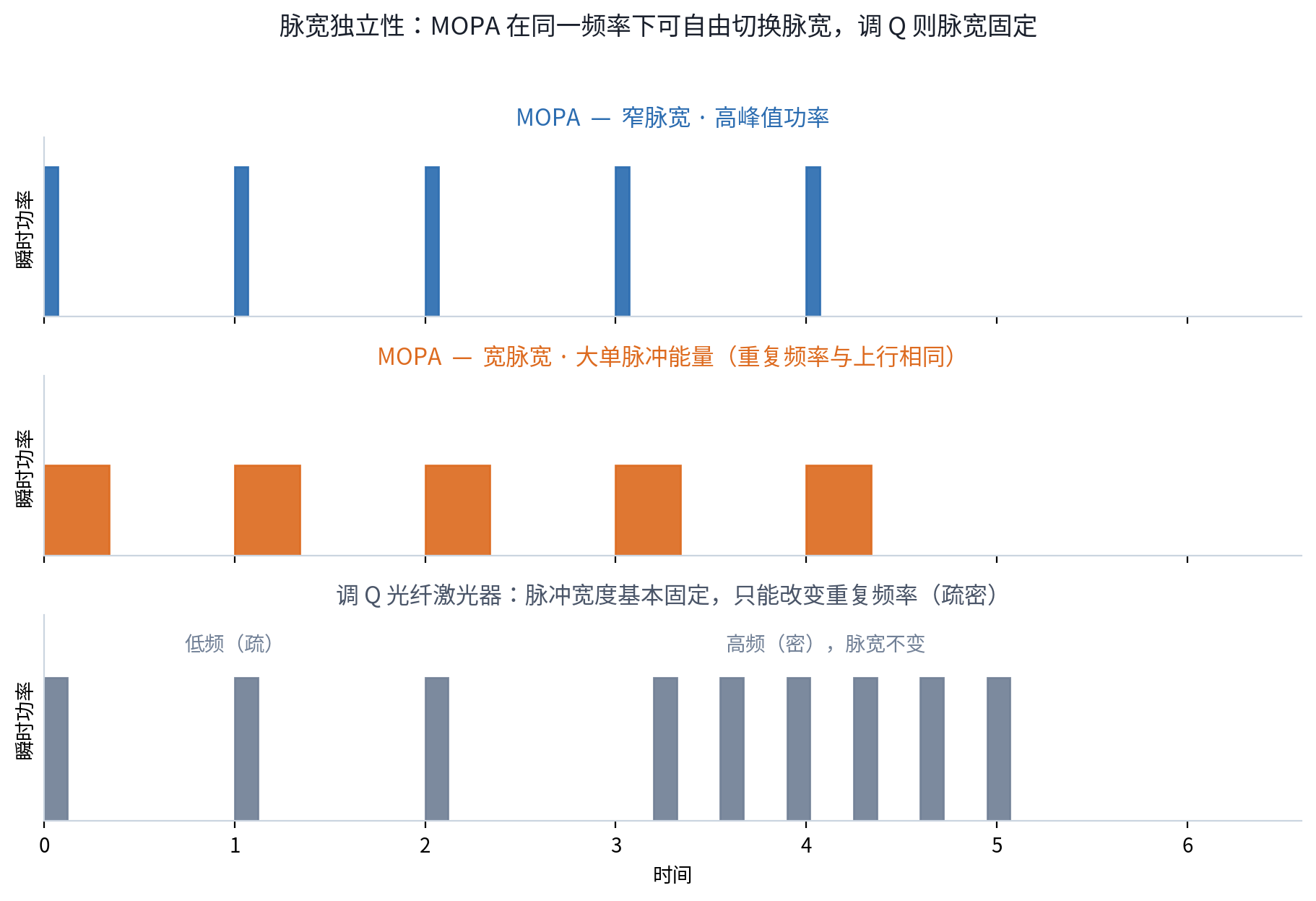
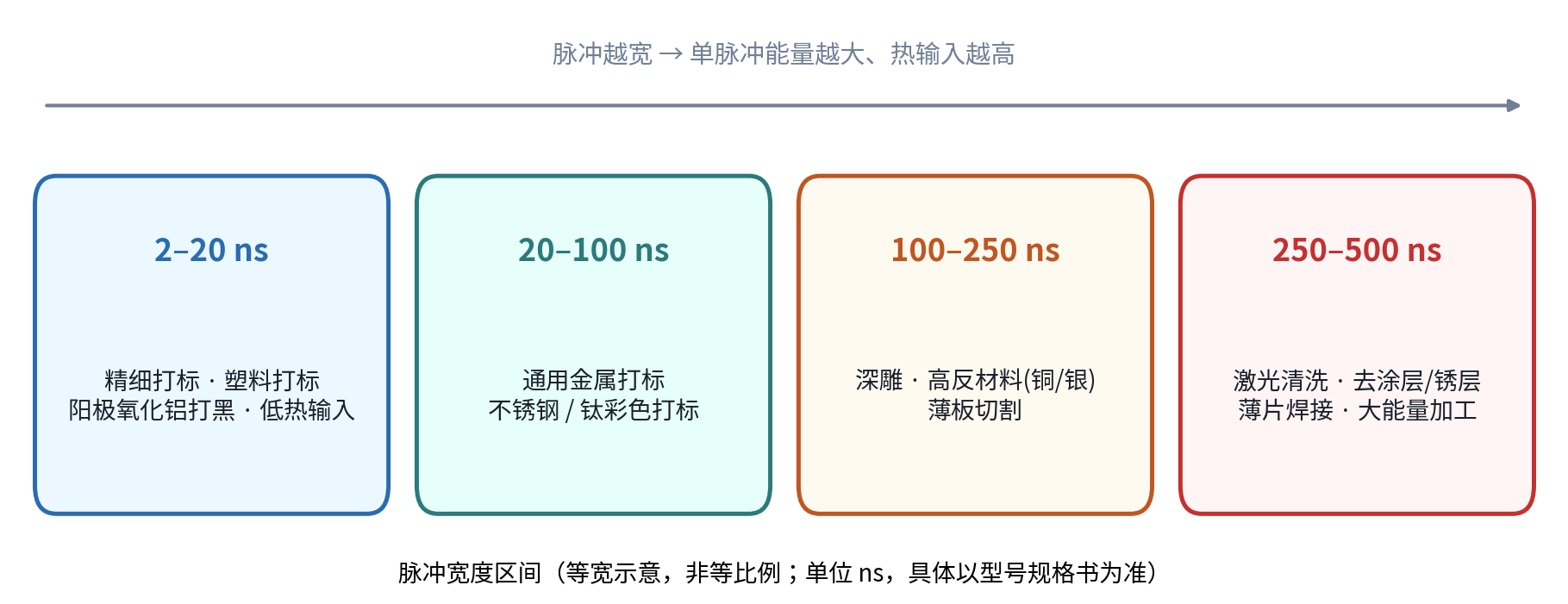
Key insight: decoupling pulse width from repetition rate is MOPA’s core. For example, the same 30 W MOPA can use a narrow pulse width (e.g. 2–20 ns) for low-heat fine marking, or a wide pulse width (e.g. 250–500 ns) to raise single-pulse energy for deep engraving, high-reflectivity material processing or laser cleaning — something an ordinary fixed-pulse-width Q-switched laser cannot do.
IV. Common myths
Myth 1: MOPA is a Q-switched fibre laser
Wrong. Q-switching generates pulses by abruptly changing cavity loss via a Q-switch within a single resonant cavity; MOPA is “low-power seed + external multi-stage amplification” — fundamentally different architecture with stronger parameter control.
Myth 2: Pulse width is fixed, only frequency can be adjusted
That is a feature of Q-switched lasers, not MOPA. MOPA’s signature capability is precisely independently adjustable pulse width.
Myth 3: Peak power is determined only by average power
Actually peak power ≈ pulse energy ÷ pulse width, and pulse energy = average power ÷ repetition rate. At a fixed average power: shortening pulse width raises peak power; raising repetition rate spreads pulse energy thinner and lowers peak power. That is how MOPA flexibly changes peak power at the same average power.
Myth 4: The amplifier only “boosts power, everything else unchanged”
Amplification brings pulse distortion from gain saturation, risk of damage from back-reflections, and limits from nonlinear effects such as stimulated Brillouin scattering (SBS) / stimulated Raman scattering (SRS) — it is not lossless amplification.
Myth 5: All marking should use MOPA
Not necessarily. For ordinary metal marking on a fixed material with a fixed pattern, a Q-switched laser is cheaper and fully adequate. MOPA’s value lies in cases with varying materials, the need for flexible pulse-width adjustment, and strict requirements on heat effects or contrast; paying extra for flexibility you do not use is not worthwhile.
V. MOPA vs Q-switched fibre lasers
| Dimension | MOPA fibre laser | Q-switched fibre laser |
|---|---|---|
| Generation method | Low-power seed source + external multi-stage fibre amplification | Q-switch inside the resonant cavity |
| Pulse width | Widely and independently adjustable (e.g. 2–500 ns) | Essentially fixed (about 100–200 ns) |
| Repetition rate | Wide (about 1–2000 kHz, higher in some models) | Narrower (mostly about 20–100 kHz) |
| Peak-power adjustment | Adjustable independently via pulse width / frequency | Mainly varies with frequency, limited adjustment |
| Pulse waveform | Programmable / pre-distortion-compensable | Fixed |
| First pulse | Usable from the first pulse, good consistency | May take several pulses to stabilize at start-up |
| Black marking on plastic / anodized aluminium, colour marking | Strong suit | Mediocre or unsuitable |
| Complexity / cost | Higher | Lower |
Conclusion: choose MOPA for parameter flexibility and broad material adaptability (colour marking, blackening anodized aluminium, plastic marking, thin-sheet cutting); for low-cost, fixed-process metal marking, Q-switched is already enough. For more on marking-system composition, see Fibre Laser Marking Machine Assembly and Selection Guide.
VI. Application scenarios
- Fine marking: narrow pulse width and low heat input, suited to micro engraving on electronic components, 3C and medical devices.
- Plastic marking: narrow pulse width produces high-contrast, low-damage marks on many engineering plastics.
- Anodized Aluminium Black Marking: specific pulse-width combinations yield high-contrast, uniform black marks, common on consumer-electronics housings.
- Colored Marking on Stainless Steel / Titanium: precise parameter control governs surface oxide-film thickness to produce colour.
- Thin Sheet & Film Cutting: such as solar photovoltaics, foils and flexible materials.
- Laser Cleaning: wide pulse width removes coatings / rust; see Laser Cleaning Encyclopedia.
- Welding and deep engraving.
VII. Selection FAQ
Q1: What is the most essential difference between MOPA and an ordinary Q-switched fibre laser?
A: architecture and pulse-width adjustability. Q-switching produces pulses via a Q-switch within a single cavity, with essentially fixed pulse width (about 100–200 ns), mainly adjusting repetition rate; MOPA first defines the pulse with a low-power seed source, then amplifies it through an external fibre amplifier, so pulse width can be adjusted independently from about 2–500 ns, with programmable waveform and better first-pulse consistency.
Q2: When must / should you choose MOPA?
A: MOPA is recommended if any of these apply: ① black marking on plastic or anodized aluminium, or colour marking on stainless steel / titanium; ② many material types requiring frequent parameter changes; ③ fine or thin-part work with strict requirements on heat-affected zone, burrs or edge blackening; ④ needing wide-pulse-width high energy for cleaning or coating removal while also wanting narrow-pulse-width fine work.
Q3: For ordinary metal marking only, is MOPA necessary?
A: usually not. For fixed-material, fixed-process marking of stainless / carbon steel, a Q-switched laser is cheaper, mature in maintenance and fully adequate. MOPA’s cost for flexibility pays off only when wide-pulse-width adjustment is actually used.
Q4: How to choose among MOPA 20 W, 30 W and 60 W?
A: for marking, 20–30 W covers most metals and some plastics; choose 60 W and above for deeper engraving, faster takt, cleaning / coating removal or high-reflectivity materials. Power is not the only metric — combine pulse-width range, frequency range, beam quality and galvo / F-theta lens configuration.
Q5: Can MOPA mark as well as cut, weld and clean?
A: it can handle these to a degree: narrow pulse width for marking, wide pulse width with low frequency and high single-pulse energy for thin-part cutting, thin-sheet welding and coating removal / cleaning. But it is a small-to-medium power, medium-to-small energy “all-rounder”; thick-plate cutting, deep-penetration welding or large-area heavy-contamination cleaning still call for dedicated medium-to-high-power lasers.
Q6: How does widening or narrowing the pulse width change the result?
A: with other conditions similar: narrower pulse width means higher peak power and smaller heat effect, suited to fine marking and black marking; wider pulse width means higher single-pulse energy and heat input, suited to deep engraving, high-reflectivity materials, coating removal and cleaning. Prototype verification is advisable, confirming actual output with pulse-width measurement.
VIII. Recommended reading
- Fibre Laser Encyclopedia: Principles, Types and Applications
- Q-Switching (Q-Switched) Technology Principles
- Active Fibre and Double-Clad Gain Fibre
- Fibre Optical Isolator
- Laser Cleaning Technology Guide
- Fibre Laser Marking Machine Assembly and Selection Guide
References
- RP Photonics Encyclopedia – Master Oscillator Power Amplifier
- RP Photonics Encyclopedia – Master Oscillator Fiber Amplifier (MOPFA)
- Raycus RFL-PxxMX series MOPA pulsed fibre laser datasheet (pulse width 2–500 ns, frequency 1–2000 kHz)
- JPT M7 / M8 series MOPA pulsed fibre laser public specifications
- Soar Laser soar-laser.cn laser encyclopedia related entries
Note: This article is technical encyclopedia content; specific products’ pulse width, repetition rate, beam quality and power are subject to official datasheets; parameter ranges differ among brands and models.
Leave a Reply