


Last updated: October 2026 | By Soar Laser
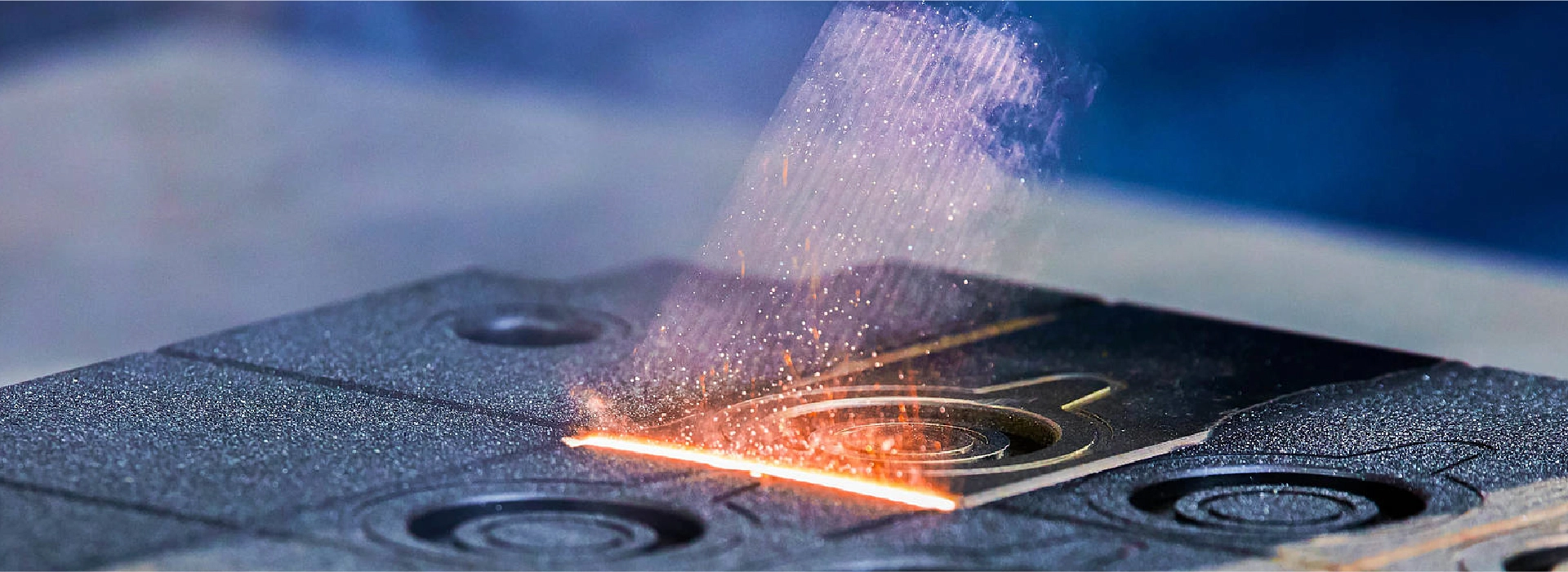
Laser cleaning (Laser Cleaning), often called “laser rust removal” or “laser mold cleaning” in the industry, is a surface-treatment technology that uses a high-energy laser beam to strip contaminants such as rust, paint, oil and oxide films from a workpiece surface. It uses no abrasive, no chemicals and does not touch the workpiece, yet achieves “removing dirt without damaging the substrate” — in recent years it has spread from rail maintenance and ship rust removal to mold cleaning and pre-weld treatment. This article systematically explains the mechanisms, the three process methods (dry / wet / inert-gas), equipment composition, typical applications, comparison with traditional cleaning, and the 8 most common pitfalls.
Key takeaways
- Laser cleaning works through three mechanisms acting together: ablation vaporization, thermal-expansion spallation and plasma shock — not simply “burning off.”
- The key to “clean without damage” is keeping the laser energy density within the process window between the cleaning threshold and the damage threshold.
- Each of the three methods has its place: dry is most common and efficient; wet uses a liquid-film burst for a gentler effect on the substrate; inert-gas shielding prevents re-oxidation, suiting demanding cases such as pre-weld cleaning.
- Equipment has five parts: pulsed laser, cleaning head, control system, cooling system and fume extraction/purification.
- Compared with sandblasting, chemical cleaning and manual grinding: non-contact, no abrasive or chemicals, collectable fumes; but efficiency and economy have limits on thick rust — rough cleaning + laser precision cleaning is the more common combination.
What is laser cleaning? A one-sentence explanation
Laser cleaning is a non-contact surface-treatment technology that uses a high-energy laser beam to remove rust, paint, oil, oxide film and other contaminants from a workpiece surface. It is an important branch of laser material processing and is essentially laser ablation targeting surface contaminants.
Its logic is not complicated: laser energy strikes the surface, the contaminant layer preferentially absorbs energy and heats instantly, vaporizing, spalling or flying off in an extremely short time, while the substrate, absorbing little energy for a short time, essentially stays unchanged. Unlike laser cutting or marking, laser cleaning acts only on “a very thin surface layer” — the goal is a clean surface, not changing the material itself.
Laser cleaning has spread rapidly these years for three reasons: first, environmental pressure — the disposal cost of sandblasting dust and chemical-cleaning waste keeps rising; second, labor cost — grinding and mold cleaning are tiring and slow; third, falling fibre-laser prices turned the whole system from a “lab technique” into an affordable factory tool. Of course, it is not a universal answer for every condition; the limits are explained below.
Why can it “remove dirt without damaging the substrate”? Three mechanisms
Laser cleaning does not rely on a single brute-force mechanism, but on a combination of three — different parameters make different mechanisms dominant, changing both the result and the suitable scenarios.
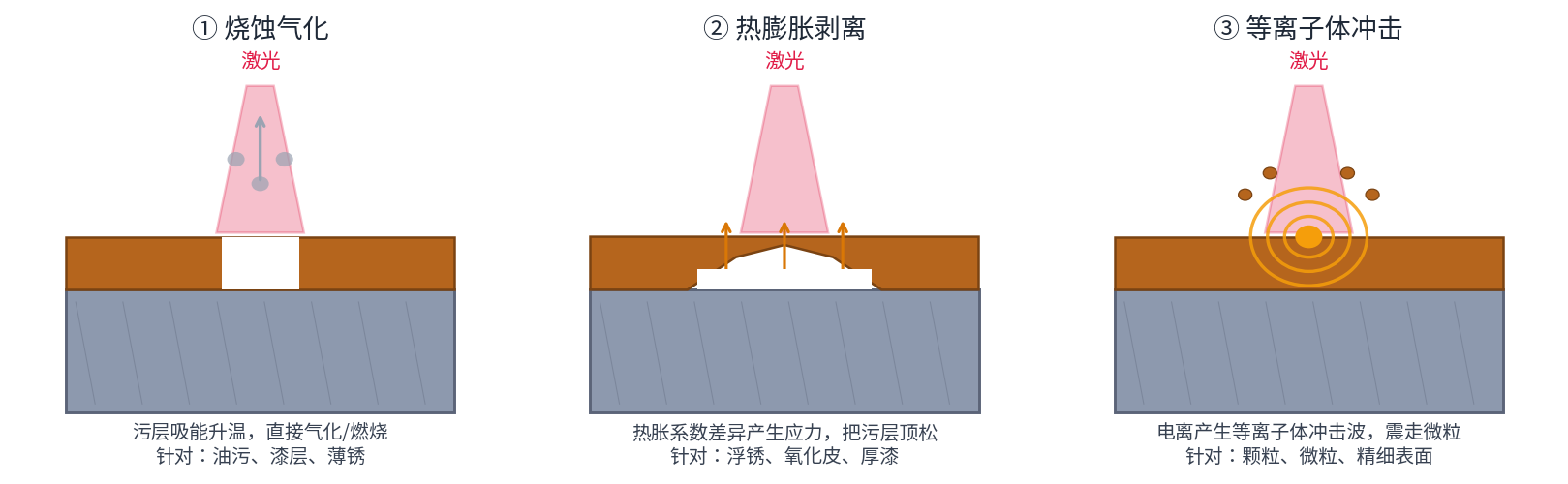
Mechanism 1: Ablation vaporization. After absorbing laser energy, the contaminant’s temperature rises sharply and it vaporizes or decomposes/burns into fumes that are drawn away by extraction. Organic contaminants such as oil and paint, and thin rust layers, are removed mainly by this mechanism.
Mechanism 2: Thermal-expansion spallation. The contaminant and substrate have different thermal-expansion coefficients, so on heating they expand by different amounts, creating transient interfacial stress that loosens and spalls the contaminant. Many paint-removal and loose-rust jobs rely on this “shock-off” effect, with the substrate barely warming.
Mechanism 3: Plasma shock. When energy density is high enough, the contaminant or gas near the surface is ionized into plasma, and the accompanying shock wave blasts the dirt away. Each laser pulse acts like a micro impact-cleaning of the surface — especially suited to particulate and fine-particle contaminants.
Another key player is short pulses: nanosecond pulses release energy in an extremely short burst, so heat has no time to diffuse into the substrate and the heat-affected zone stays very small — English sources call this low-heat-load removal “cold ablation,” which does not mean no heat at all, only that heat has no time to spread deep into the substrate. This is the first prerequisite for “no substrate damage”; the second is finding the right energy range:
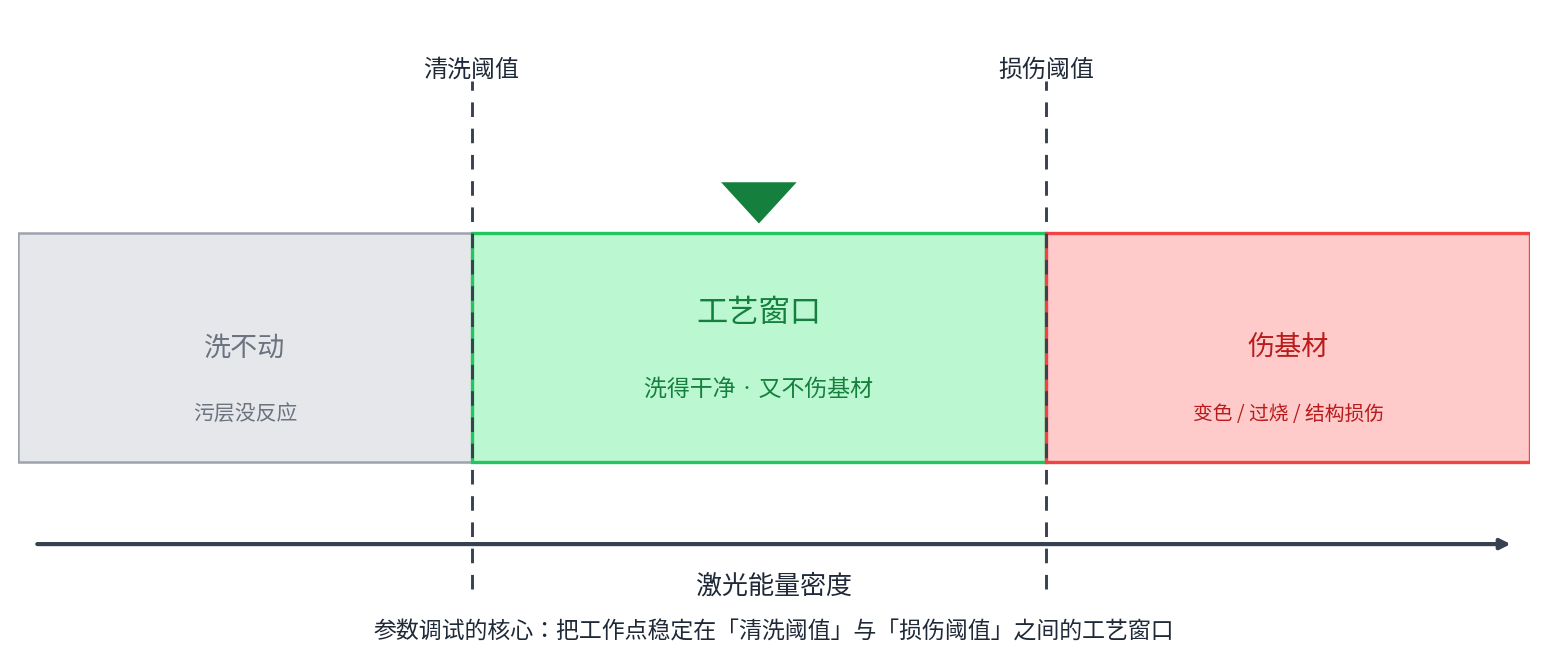
Too low an energy density leaves the contaminant untouched; too high and the substrate discolors, overheats or even suffers structural damage. The core of all laser-cleaning parameter tuning is keeping the operating point stable within this middle “window.” In practice, selectivity is further improved by controlling focal position and using a shallower angle of incidence. The division among the three mechanisms is shown below:
| Mechanism | Plain-language understanding | Main targets | Features |
|---|---|---|---|
| Ablation vaporization | Directly “evaporates” the contaminant | Oil, paint, thin rust | Generates fumes, needs extraction/purification |
| Thermal-expansion spallation | Expansion/contraction “pushes” the contaminant off | Loose rust, scale, thick paint | Little heat effect on substrate |
| Plasma shock | A micro shock wave “shakes” the dirt off | Particles, fine particles, delicate surfaces | High energy density required |
Three process methods: dry, wet and inert-gas shielding
By the “medium” on the workpiece surface during laser action, laser cleaning splits into three process methods, each with its own character.
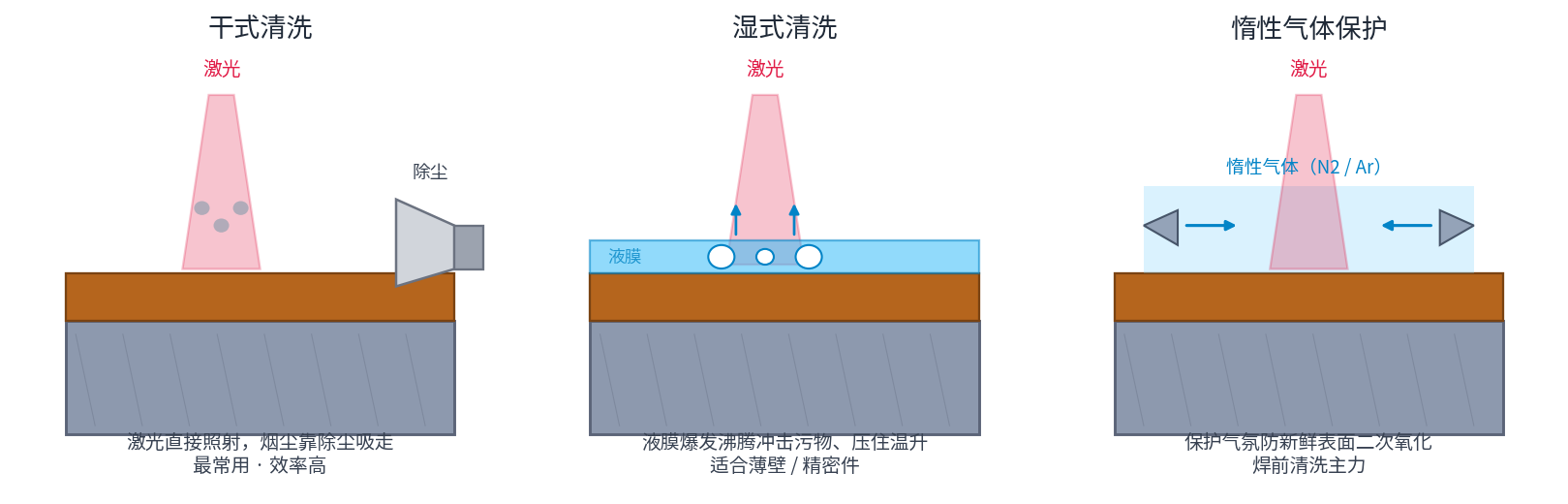
Dry cleaning: the efficiency champion and the most common method
A pulsed laser irradiates the workpiece directly, the contaminant vaporizes or spalls, and an extraction system draws the fumes away. Simple and efficient, it is the mainstream method for rust and paint removal today. Note that the fumes and spatter generated must be collected by a purification system, otherwise the workshop is polluted and the operator’s health affected.
Wet cleaning: adding a “cushion” to the substrate
Before cleaning, a liquid film (most often water, sometimes ethanol) is spread on the surface; the laser passes through the film to act on the contaminant: the liquid absorbs part of the energy and boils violently, and the burst of impact carries the dirt away, while the film acts as a cushion holding down the substrate’s temperature rise. Research often classifies wet cleaning into strong-substrate absorption, combined substrate-and-film absorption and strong-film absorption by how energy is distributed between substrate and film. It suits “heat- and deformation-sensitive” workpieces such as thin-walled and precision parts; the cost is extra liquid handling and drying steps.
Inert-gas-shielded cleaning: preventing re-oxidation, the mainstay of pre-weld cleaning
An inert gas such as nitrogen or argon forms a protective atmosphere over the cleaning zone, preventing the freshly exposed surface from re-oxidizing and reducing spatter falling back and adhering. A typical scenario is pre-weld cleaning — aluminium-alloy and stainless-steel weldments must be welded immediately after oxide removal, and surface condition directly determines weld quality, which justifies inert-gas shielding.
| Method | Key principle | Advantages | Limitations | Typical scenarios |
|---|---|---|---|---|
| Dry | Direct laser irradiation, contaminant vaporizes / spalls | High efficiency, simple setup | Large fume volume, extraction mandatory | Steel structures, ship rust removal; paint removal |
| Wet | Liquid-film burst carries dirt away | Low substrate temperature rise, suits precision parts | Needs liquid handling and drying | Thin-walled and precision parts, heat-sensitive materials |
| Inert-gas shielding | Inert atmosphere prevents re-oxidation | High surface quality, prevents rust return | Needs a gas supply, slightly higher cost | Pre-weld cleaning, demanding surfaces |
What parts does laser-cleaning equipment have?
A laser-cleaning system has five core parts:
| Component | Function | Key points |
|---|---|---|
| Laser | Generates the cleaning laser | Mainly nanosecond pulsed fibre lasers, average power from hundreds of watts to over a kilowatt; MOPA structure allows adjustable pulse width — narrow for precision, wide for efficiency |
| Cleaning head | Delivers the laser precisely to the surface | Handheld gun or automated integration; uses galvo scanner for scanning and F-theta lens for focusing; the front protective window is a common consumable |
| Control system | Parameter setting and path control | Process-parameter library, robot / machine-tool linkage, safety interlocks; some models have camera monitoring |
| Cooling system | Controls laser temperature | High-power models use chillers; low power can be air-cooled |
| Fume extraction/purification | Collects fumes and spatter | Essential for rust and paint removal; filters and cartridges replaced periodically by condition |
The laser is the “heart.” Most cleaning systems today use nanosecond pulsed fibre lasers — short pulses and high peak power remove the contaminant while suppressing substrate temperature rise. Unlike Q-switched machines with relatively fixed pulse width, MOPA (master oscillator power amplifier) allows pulse width and frequency to be adjusted independently, so one machine covers conditions from fine paint removal to fast rust removal — the reason it is the mainstream cleaning light source. A few special conditions use continuous lasers (e.g. direct-diode lasers), but conventional rust and paint removal is almost always pulsed.
What can laser cleaning remove? 8 typical applications
| Scenario | Typical targets | Notes |
|---|---|---|
| Metal rust removal | Bridge steel structures, ships, tanks, pipelines | Local or large-area rust removal, especially for precision areas sandblasting cannot reach; long-pipe inner walls can be cleaned by robots |
| Paint / coating removal | High-speed-train bodies, aircraft skins, auto wheels and parts | “Peeling” paint removal without harming the metal substrate, suited to maintenance and rework |
| Mold cleaning | Tire molds, injection / die-casting molds, extrusion dies | Removes carbon buildup, release-agent residue and rust scale, shortening downtime |
| Pre- and post-weld treatment | Weld seams, aluminium-alloy and stainless-steel weldments | Pre-weld removal of oxide film and oil improves weld quality; post-weld cleaning removes weld oxides |
| Oil and grease removal | Gears, bearings, rolls, guideways | Precision-part degreasing without surface damage, no cleaning-fluid residue |
| Oxide / coating removal | Bus bars, electrodes, connectors | Selective removal of local oxide layers, restoring conductivity and weldability |
| Precision and electronics | Medical devices, sensors, small parts | Non-contact, precise positioning, suited to targeted local cleaning; in medical settings often a pre-cleaning or complementary step |
| Cultural relics and architecture | Stone carvings, metal artifacts, building facades | Layer-by-layer controllable cleaning, used by cultural-institution researchers for artefact restoration |
Beyond the traditional scenarios above, demand is rising fast for battery-electrode cleaning in new energy, robotic cleaning of oil and gas pipeline inner walls, and surface pre-treatment before bonding or coating — the list for laser cleaning keeps growing.
Compared with sandblasting, dry ice and chemical cleaning — what is stronger?
The most common question before buying is: how exactly is it better than traditional methods, and where does the cost go? A direct comparison:
| Cleaning method | Effect on substrate | Environmental impact and waste | Typical suitability |
|---|---|---|---|
| Laser cleaning | Non-contact; with sound parameters essentially no substrate damage | No abrasive or chemicals, fumes collectable | Rust and paint removal, molds, pre-weld treatment, precision parts |
| Manual grinding | Mechanical contact, may scratch or alter surface texture | Dust and noise | Small-area rough treatment |
| Sandblasting | Impact abrasion, thin parts deform easily | Large amounts of abrasive and dust | Large-area rust removal (rough treatment) |
| Dry ice cleaning | Impact plus low temperature, stress risk for thin parts | Dry ice sublimates, no secondary waste | Molds, oil-based cleaning |
| Chemical cleaning | Corrosion risks (hydrogen embrittlement, over-corrosion) | Wastewater and exhaust need treatment | Batch processing of regularly shaped parts |
| Ultrasonic cleaning | Gentle, but needs immersion, mostly for small parts | Needs cleaning fluid and water | Precision cleaning of small parts (offline) |
Laser cleaning’s value comes down to one line: high-value parts, environmentally sensitive settings, precision rework. For rough treatment of large areas with thick rust, its efficiency and economy may not beat sandblasting — hence the common practice of “rough cleaning + precision cleaning”: sandblasting or high-pressure water does the initial pass, laser handles the final precision surface.
How to choose laser-cleaning equipment and parameters? Answer 4 questions first
- What are you cleaning? Is the layer rust, paint, oil or oxide, and how thick — this determines mechanism emphasis and method choice.
- What does the substrate fear? Thin parts fear deformation, precision parts fear scratches, highly reflective materials need reflection control — this sets the energy-density ceiling.
- Which method to use? start with dry by default; consider wet for heat-sensitive or thin-walled parts; add inert-gas shielding for demanding cases such as pre-weld cleaning.
- How to set parameters? do a small-sample trial wash first and find the process window between “clean” and “undamaged”; prefer machines with a wide adjustable range of pulse width and frequency to cover more conditions.
On the equipment spec sheet, focus on these items: laser type and average power, single-pulse energy, pulse width, scan width, focal length / working distance, cleaning-head weight, cooling method, fibre length, safety features and extraction package. Power and spot are complementary — with limited power, tight focusing maintains energy density but slows the work; with ample power, a “line” spot cleans a wider strip in one pass, more efficiently.
An extended question: should the Gaussian spot be shaped into flat-top for more uniform energy, or is a DOE diffractive optical element needed? That depends on whether the process is scanning with overlap or single-shot processing; see “Should Laser Cleaning Convert Gaussian to Flat-Top? Do You Need DOE Beam Shaping?”.
Before purchase, sending samples to the supplier for a trial clean and agreeing acceptance criteria says more than the numbers on a spec sheet.
8 common myths about laser cleaning
- Myth 1: Higher power cleans better. Wrong. Energy density past the damage threshold harms the substrate; the right approach is finding the window between cleaning and damage thresholds — if it is not clean, do more passes rather than forcing more power.
- Myth 2: “Laser cleaning never damages the substrate.” Conditionally true. With sound parameters most metals clean without damage — e.g. experiments on screw-type parts showed no significant surface-roughness change before and after cleaning; but thin parts, high-reflectivity mirrors and composites must be validated individually — polymers in particular are harder because contaminant and substrate absorption are similar, so do not assume.
- Myth 3: “One laser flash burns the dirt off.” Incomplete. Ablation vaporization is only one mechanism; many cases rely on thermal-expansion spallation and plasma shock to “shake the dirt off,” with the substrate barely warming.
- Myth 4: “Wet cleaning is just washing with water running.” No. The key is the “liquid film”: under laser action the film boils explosively and creates local impact, stripping dirt while cushioning the substrate’s temperature rise — different from simply running water to cool.
- Myth 5: One parameter set cleans all workpieces. It cannot. Material, contaminant type and thickness, and precision requirements differ, so parameters need tuning, with rough and fine cleaning in stages where necessary.
- Myth 6: Laser cleaning uses many consumables and is expensive to run. Quite the opposite. Daily consumption is mainly electricity and a few wear parts (protective windows, filters etc.); there are no bulk consumables like abrasive or chemicals.
- Myth 7: One clean lasts forever. It does not. A freshly cleaned surface will re-oxidize and rust if not protected promptly, so coating, welding or anti-rust treatment should follow immediately; demanding cases can use inert-gas-shielded cleaning.
- Myth 8: Laser cleaning can replace all cleaning processes. Not across the board. For large areas with thick rust or heavy oil, laser cleaning’s efficiency and economy have limits; rough cleaning + laser precision cleaning is more common.
Laser cleaning FAQ
Does laser cleaning damage the substrate?
With parameters inside the process window, laser cleaning has very little thermal and mechanical effect on metal substrates; experiments show no significant surface-roughness change before and after cleaning under sound parameters. But “no substrate damage” has prerequisites — every material and thickness must be validated with a trial clean; a manufacturer’s general claims cannot be copied directly.
How thick a rust layer can laser cleaning remove, and how efficient is it?
Loose rust and thin layers usually take a single pass; thick rust needs multiple passes, or sandblasting / high-pressure water as a rough treatment first. Efficiency depends on machine power, spot size, scanning speed and operating method — there is no universal figure; sending samples for a trial clean and agreeing acceptance criteria before purchase is advisable.
Will the surface rust again after laser cleaning?
Yes. The freshly cleaned surface exposed to air will re-oxidize, so coating, welding or protective treatment should follow promptly. For processes demanding high surface condition (e.g. pre-weld cleaning), inert-gas shielding is recommended to avoid oxidation during cleaning.
Is a laser-cleaning machine safe? What should operators watch?
Handheld cleaners are mostly Class 4 laser products: never look directly at the beam, wear laser safety glasses for the correct wavelength, watch for specular reflection, and set up warning isolation in the work area; during rust and paint removal, run the extraction system to avoid inhaling fumes. See the encyclopedia entries Laser Hazard Classes and Laser Safety Glasses.
Is laser cleaning expensive to run?
Running cost is not high: daily consumption is mainly electricity and a few wear parts, with no bulk consumables like abrasive or chemicals; over time it saves considerably on consumables and waste disposal versus sandblasting and chemical cleaning. What needs evaluating is the initial equipment investment and the long-term maintenance budget for the laser and optics — match power and configuration to the condition, and do not pay for performance you do not need.
Related accessories and further reading
Soar Laser supplies laser cleaning heads, dedicated cleaning lasers and accessories (galvos, F-theta lenses, protective windows etc.), selected to suit your condition. For more system knowledge, see:
- What is Laser Material Processing? The Optical Processing Revolution in Manufacturing
- What is a Fibre Laser? Why It Dominates the Industrial Laser Market
- Q-Switching Explained: Active vs Passive, Nanosecond Pulses and Giant Pulses
- Laser Scanning Galvo Scanner: Principles and Applications
- Laser Protective Window Encyclopedia: Selection and Materials Explained
- Laser Hazard Classes: What Differs from Class 1 to Class 4
- Laser Safety Glasses: How to Read the OD Value
- Laser Encyclopedia Index (164 articles)
References: “Laser Cleaning Technology in Industry” (China Optics Journal Network, opticsjournal.net); RP Photonics Encyclopedia: Laser Cleaning (rp-photonics.com); “Research on Key Technologies of Picosecond Laser Cleaning of Stone Cultural Relics” (Palace Museum, dpm.org.cn); IEC 60825-1 / GB 7247.1 laser product safety standards (iec.ch).
Leave a Reply